

TIE champions digital learning, innovation in 50-year milestone
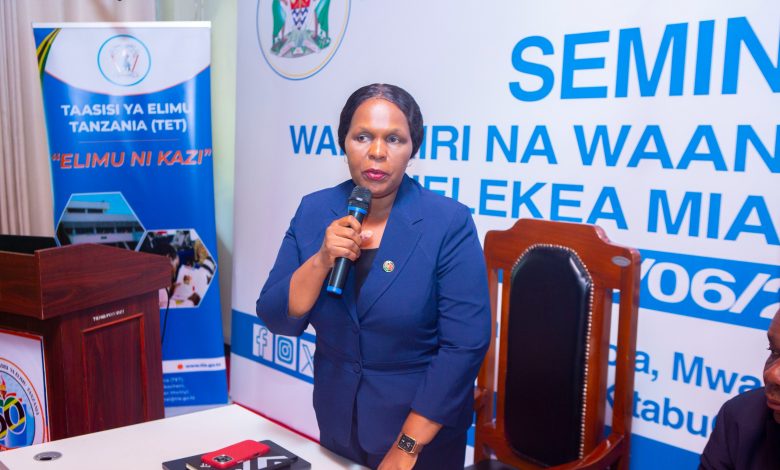
DAR ES SALAAM: THE Tanzania Institute of Education (TIE) yesterday highlighted its key achievements over the past five decades, emphasizing its pivotal role in transforming the country’s education landscape through curriculum development, inclusive learning, digital innovation and research partnerships.
Speaking at a media seminar for editors and journalists in Dar es Salaam, held ahead of the official anniversary celebrations, TIE Director General Dr Aneth Komba presented a comprehensive overview of the institute’s milestones since its establishment in 1975.
“One of our greatest successes has been the growth in academic capacity,” Dr Komba noted.
She added: “We started with just two staff members holding doctoral degrees. Today, we have 15 PhD holders who are leading our academic and research efforts.” Dr Komba highlighted that TIE has revised the national curriculum six times since independence to meet evolving educational demands.
The institute is responsible for developing all core textbooks and teacher guides from pre-primary through teacher training levels.
The materials are also available in braille and large print, ensuring access for visually impaired learners.
“TIE is committed to inclusive education, we believe that every learner, regardless of ability, has the right to quality education,” she said.
A key innovation has been the introduction of Tanzania’s first Sign Language Dictionary, designed to support teaching and communication for deaf students.
Dr Komba said the institute has expanded its digital footprint by launching a national digital library and an online learning platform offering interactive, self-paced content for primary and secondary students.
The education sector has also benefited from Soma Kwanza TV, a curriculum-based television channel that delivers educational content directly to learners.
Moreover, smart classrooms equipped with modern ICT tools have been established in Dodoma and Kibaha.
Dr Komba underscored the importance of technology in professional development.
ALSO READ: Stakeholder’s join hands to boost digital learning
“We’ve developed a Learning Management System (LMS) that provides teacher training modules online. It’s currently free to access through Airtel and we are working on partnerships with other telecoms to widen access,” she said.
Between 2023 and 2025, TIE has trained over 181,000 pre-primary and primary school teachers, 103,000 secondary teachers, and more than 1,300 college instructors.
A national competition to promote innovative teaching practices has also been introduced.
TIE’s research efforts have expanded through local and international partnerships.
In collaboration with the University of Dar es Salaam, Aga Khan University, and EdTech Hub, the institute explored cost-effective digital solutions for rural teacher training.
Another achievement is the programme called, “Seeing is Learning,” conducted with Western Norway University of Applied Sciences, focused on identifying and supporting visually impaired students.
Most recently, TIE partnered with Georgetown University, the University of Delaware, and the University of Dar es Salaam for the
“What Works Hub for Global Education” project, which led to the creation of the TIE-Ed-Lab, funded with British Pounds Sterling (GBP) 1.99 million.
Despite facing challenges such as outdated printing equipment and a shortage of specialists in creative subjects, TIE remains optimistic.
“We are working closely with the government and private sector to address these gaps,” Dr Komba said



160632 19602Likely to commence a business venture about the refers to disclosing your products and so programs not just to individuals near you, remember, though , to several potential prospects much more via the www often. earn dollars 28504