Russia’s Fisherman and the Golden Fish brightens Tanzanian night
DAR ES SALAAM: ON Friday evening in Dar es Salaam, as the sun dipped low and the city buzzed with the promise of weekend escape, most people were leaving work to unwind; a large and captivating cultural event was unfolding at the Russian Centre for Science and Culture
The event coincided with Russian Language Day, celebrated annually on June 6 to honour the Russian language and its literary heritage.
As part of the celebration, the Center featured a stage play adaptation of the famous Russian folktale “The Fisherman and the Golden Fish” ( Mvuvi na Samaki in Kiswahili language) by legendary Russian poet Alexander Pushkin, who is notably of African roots.
The evening began in a secondary hall where guests were welcomed with large-screen animations introducing Pushkin’s life and the story’s premise. These short cartoons captivated the audience, offering a visual appetizer for the full play that would soon follow.
The stage play was organized by African Film Arts and Social Revolution (AFASR) in collaboration with the Russian Centre for Science and Culture.

The event drew notable attendees, including officials from BASATA (National Arts Council of Tanzania), Copyright Society of Tanzania (COSOTA), and the Tanzania Film Board.
Before the curtain rose, Alexander Evstigneev, Director of the Russian Centre, offered a brief but engaging speech on the significance of the Russian language and Pushkin’s legacy.
Attendees, already drawn in by the ambiance, listened closely and built anticipation for the play.
ALSO READ: DERBY CLASH SUSPENSE: Yanga, TFF ping pong rages on
The main hall had been transformed with immersive visuals. A calm ambiance filled the room, accompanied by soft background music. When the elegantly dressed host stepped forward to welcome the audience and introduce the performance, all eyes turned to the stage.
The stage glowed with digital projections of seascapes, traditional boats, and even luxurious palaces, helping to visually communicate the transitions in the story. Sound effects such as ocean waves, winds, thunder, and rain added to the realism, creating an engaging sensory environment.
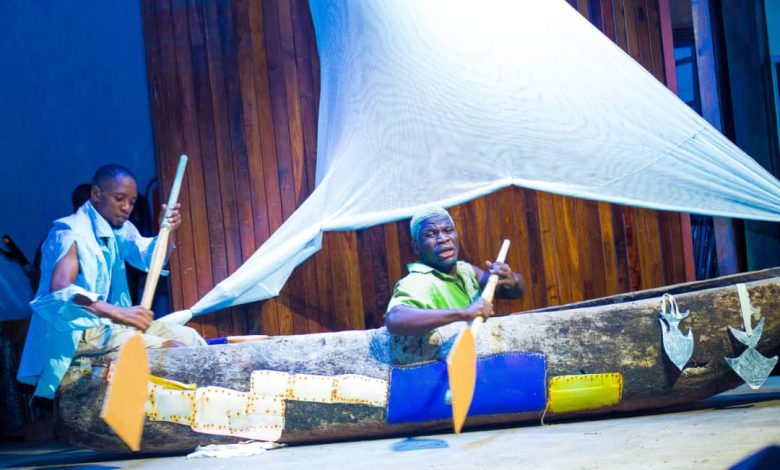
The performance opened with three young men carrying fishing nets, followed by three women who danced in a graceful introduction. Soon after, a wooden boat appeared, symbolizing the fishermen’s journey out to sea. Applause rippled through the crowd as the story came to life.

An old woman appeared on stage, preparing fishing gear for her husband, affectionately referred to as “Old Grandpa.” She encouraged him to go fishing, expressing frustration over their difficult life despite his hard work.
When the old man goes fishing, he meets three other young fishermen and eventually encounters a magical golden fish that promises to grant his wishes.
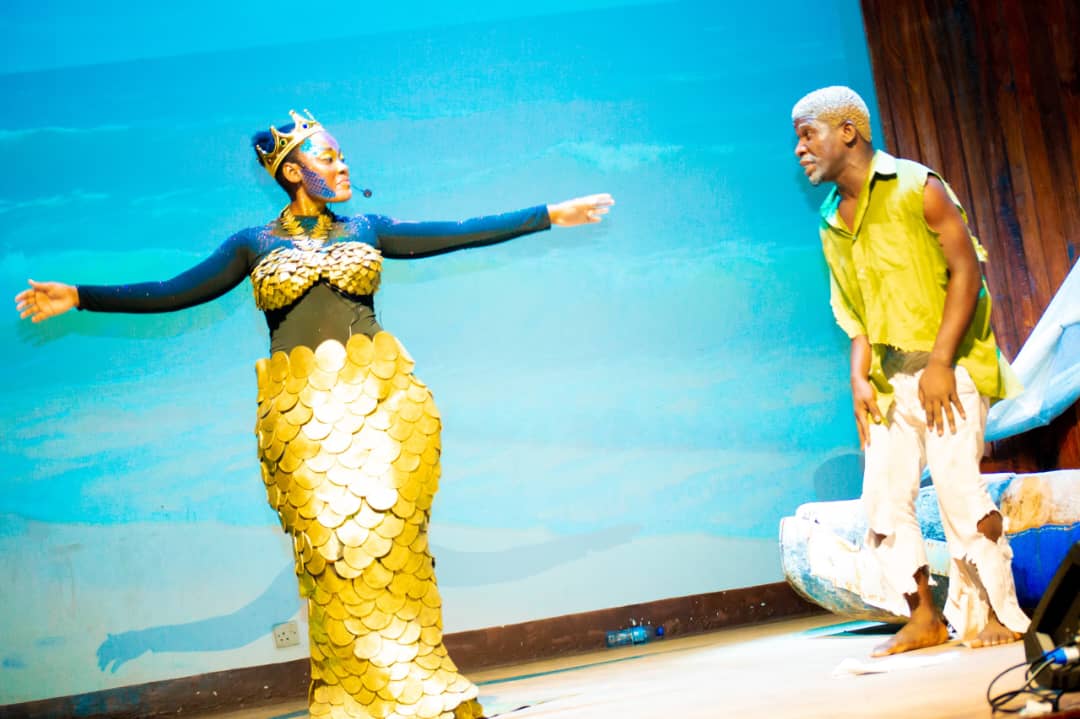
However, it is the old man’s wife who begins making demands. Initially, she asks for a better house, then for royal status, and finally, for absolute power even over the golden fish itself.
The fisherman, in contrast, asks for nothing for himself, only fulfilling his wife’s endless desires. Ultimately, the fish becomes angry with her greed and revokes all the gifts, leaving the couple back in their original, humble state.

The audience responded emotionally, particularly to the old man’s performance, which evoked deep sympathy. His selflessness, quiet suffering, and mistreatment by his wife drew heartfelt reactions.

Conversely, the character of the grandmother received criticism for her selfishness, with the audience expressing satisfaction when her privileges were taken away.
The performance also included a live musical segment, with songs reflecting the story’s themes and emphasizing the emotional journey of the characters, especially the old man.
After the play, Mr Alexander Evstigneev explained in an interview that the fusion of storytelling and live theatre was intended to promote reading culture.
He emphasized that the message of the play was open to interpretation. “In the story, everyone can find their meaning, maybe it’s about love, or sacrifice,” he said. “I believe every guest found something to take home.”
Benedict Valentino Mwegelingoha, Film Development Officer at the Tanzania Film Board, revealed the board’s plan to revive stage plays across Tanzania as a means of job creation and cultural development.

“One of our goals in the 2024/2025 work plan is to support the return of live stage performances, which provide employment and bring people together to witness real, live storytelling”, he noted.
Director Nyakwesi Silas Mujaya of AFASR, who adapted the story for the stage, said the Russian folktale was deliberately presented in a way that resonates with African audiences.
“Though it’s set in Russia, the themes are universal greed, humility, and consequence are part of our reality too,” she explained.

She added that reviving stage theatre could help strengthen the broader film industry by training more disciplined performers.
Said Bakari Twaha, who played the main character of the old fisherman, described the opportunity as a breakthrough.
“Being chosen as the main character was a huge honor. I put my all into it, and I’m grateful Tanzanians received me so warmly,” he said.
He noted the intensity of performing live: “Stage acting is tough. There are no retakes. You must be emotionally present and focused throughout.”
Zena Feisal, who portrayed the golden fish, noted the physical challenge of her costume, which forced her to stand throughout the performance, but expressed joy at contributing to the impactful production.
Performer Happiness Kichenje, who was portrayed as a beautiful grandma, echoed the sentiment. “Art must touch people, and tonight it did. Stage acting is where raw talent lives,” she said.
She added: “We hope the government brings back this art form in full force.”
The evening concluded with warm appreciation from the audience, reinforcing the importance of cultural exchange, live performance, and the timeless power of storytelling.