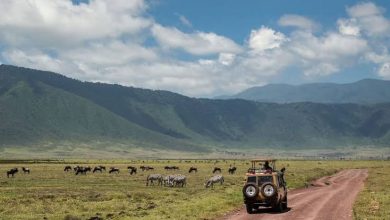
TANAPA wins rare Treasury Registrar Praise as revenue triples, investment surges

DAR ES SALAAM: TANZANIA’S national parks has earned high-level government recognition after more than tripling its revenue in five years, expanding wildlife conservation operations and attracting growing private-sector investment into the country’s protected areas.
The Treasury Registrar, Nehemia Mchechu, commended TANAPA for its financial performance and contribution to the national economy, while urging the institution to strengthen management accountability, operational efficiency and the productive use of public assets.
His remarks came on November 27, 2026, at the conclusion of a five-day leadership development programme for TANAPA’s management team at the APC Conference Centre in Bunju, Dar es Salaam.
The agency’s financial performance provided a central measure of its progress. Revenue increased from TSh174.7 billion in the 2021/22 financial year to TSh534 billion in 2025/26, representing more than a threefold expansion.
Cumulative revenue over the five-year period reached approximately TSh1.96 trillion, highlighting the growing economic contribution of wildlife tourism and the commercial potential of Tanzania’s national parks.
Visitor numbers also more than doubled, rising from approximately 789,000 to 1.56 million over the same period. The growth reinforces the strategic importance of protected areas to Tanzania’s tourism industry and wider economy.
TANAPA manages 21 national parks covering 97,078 square kilometres, equivalent to approximately 10.3 per cent of the country’s total land area. Its mandate places the agency at the intersection of biodiversity protection, tourism development and the management of nationally significant natural assets.
However, the institution’s performance extends beyond revenue generation and visitor growth.
Over the past five years, TANAPA conducted more than 31,000 patrols, apprehended over 30,000 suspects linked to poaching-related activities and confiscated thousands of illegal traps.
The enforcement operations have been complemented by stronger wildlife monitoring, increased surveillance and the adoption of modern technologies to address threats to wildlife populations and fragile ecosystems.
For Tanzania, the economic case for conservation depends on maintaining the ecological integrity of the parks that underpin its international tourism appeal. The challenge is to expand tourism-related commercial activity without undermining the natural assets on which the industry depends.
Private investment is becoming an increasingly important component of that strategy.
By November 2026, investors had established 115 permanent accommodation facilities across 13 national parks, comprising 93 tented camps and 22 hotels.
Serengeti accounted for 60 facilities, followed by Tarangire with 18, Ruaha with 10 and Nyerere with nine. The remaining facilities were distributed across other parks.
Seasonal accommodation investment has expanded even further, with 315 facilities operating across seven national parks.
Serengeti dominates this segment, hosting 276 facilities, equivalent to 87.6 per cent of the total. Tarangire accounts for 25, Nyerere eight and Ruaha three, while Arusha, Lake Manyara and Mkomazi each have one.
The concentration of accommodation in Serengeti reflects its established position as Tanzania’s flagship wildlife destination and a major magnet for hospitality capital. Tarangire is also consolidating its position as an important investment destination.
The figures, however, reveal an uneven geographical distribution of tourism infrastructure, highlighting the opportunity to channel more investment into less-developed circuits.
TANAPA has identified 130 potential sites for tourism accommodation investments, particularly across the Southern, Eastern and Western tourism circuits.
Meanwhile, total bed capacity in the national parks increased from 575 in 2021 to 1,294 in 2026, reflecting the expansion of accommodation infrastructure and the growing capacity to host visitors.
Mchechu urged the agency to market these opportunities more aggressively, deepen partnerships with private investors and improve the business environment to attract additional capital.
He also challenged management to translate leadership development into measurable institutional improvements, particularly higher productivity, operational efficiency and revenue performance.
The programme, conducted by the Tanzania Public Service College, covered strategic leadership, management ethics, human resource administration, public service legislation, records management, military protocols and teamwork.
TANAPA Conservation Commissioner Massana Mwishawa welcomed the government’s recognition of the institution’s performance, saying the leadership programme would strengthen the capacity of managers to deliver on the agency’s mandate.
He reaffirmed TANAPA’s responsibility for managing 21 national parks, three liaison offices in Dodoma, Dar es Salaam and Zanzibar, as well as five historical sites entrusted to the institution.
Mwishawa also underscored the importance of involving communities living around national parks in conservation and sustainable tourism, arguing that local populations must share in the economic opportunities generated by protecting natural resources.
TANAPA’s expanding revenue base, rising visitor numbers and growing private-sector participation illustrate how conservation can function as an economic asset rather than simply a public expenditure obligation.
The next test will be whether the agency can sustain this growth while broadening investment beyond established tourism destinations and ensuring that commercial expansion remains compatible with ecological sustainability.
For Tanzania, the long-term value of its national parks will ultimately depend not only on how much revenue they generate, but also on how effectively their natural capital is protected for future generations.