When climate diplomacy breaks down, Africa pays the price: What should TZ do next?
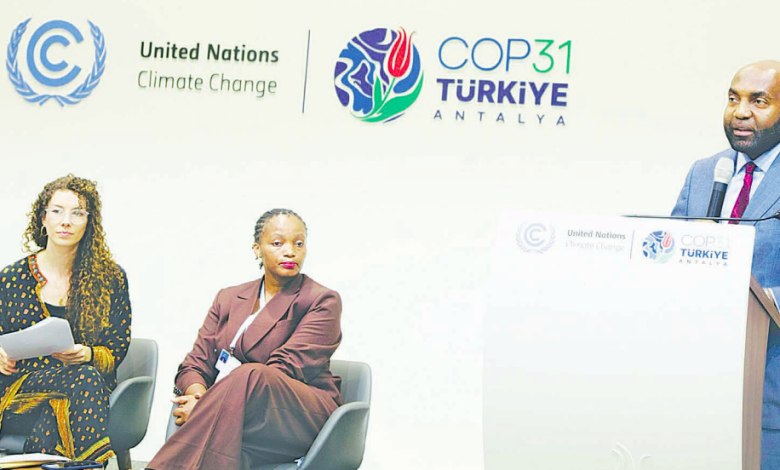
DAR ES SALAAM: IT was interesting to witness the arguments on both sides. The UN climate talks collapsed last Sunday, in Antalya, Turkey, after the European Union and others rejected a final deal proposed by the COP31 presidents of Turkey and Australia, calling it too weak to advance the fight against global warming.
Even after President Dr Samia Suluhu Hassan, made her call for transparency, especially on carbon trading and its markets, the failed talks highlight how governments around the world are struggling to take ambitious action against the worsening effects of climate change including heatwaves, wildfires, floods and powerful storms while wars and economic pressures compete for their attention.
At its core, the collapse of negotiations in Antalya reveals deep divisions over fossil fuels, climate finance and the future of global development.
For Africa, the consequences go beyond diplomacy, affecting food security, energy investment, infrastructure resilience and the financing of national development.
The central message from COP31 is that the world has not abandoned climate action, but governments have failed to agree on an overarching political outcome when cooperation is urgently needed. This distinction matters.
The summit in Antalya, Türkiye, ended on Sunday without a consensus agreement on the main political issues, after negotiations ran beyond their scheduled Friday conclusion.
However, decisions on specific issues, including adaptation and just transition, were advanced. Existing commitments under the Paris Agreement also remain in force.
For African countries, strategically, this is more than a diplomatic disappointment. It raises questions about who will finance climate adaptation, who will bear the cost of transitioning energy systems, and whether developing economies can pursue industrialisation without being constrained by an international climate agenda that does not adequately recognise their development circumstances.
Without going into too much detail, one question is why COP31 failed to reach an agreement. It was a privilege to hold high-level talks with some delegates.
The immediate reason was that nearly 200 participating countries could not agree on the final overarching political text, commonly known as the cover decision.
Two major disagreements proved especially difficult to resolve: the future of fossil fuels and the provision of climate finance for developing countries. First, disagreement over fossil fuels emerged as the decisive obstacle.
The European Union, the United Kingdom, several Pacific Island states, and other countries wanted the final text to explicitly acknowledge the need to transition away from coal, oil and gas. More than 130 countries had called for this language, but Saudi Arabia, Russia and other fossil-fuel-producing countries opposed its inclusion.
The final draft did not explicitly mention fossil fuels, a decision several countries saw as a retreat from the direction set at COP28 in Dubai in 2023.
Analytically, this disagreement reflects a fundamental tension between climate objectives and national economic interests.
Countries that rely on petroleum, gas and coal revenues worry about the economic consequences of a rapid transition, including its effects on energy security, employment, export earnings and government revenue.
Those calling for stronger language argue that continued reliance on fossil fuels undermines the scientific goal of limiting global warming. Second, climate finance remained unresolved.
Developing countries sought clearer, more credible funding commitments from wealthier nations to support adaptation, especially in countries already facing floods, droughts, heatwaves and other climate-related losses.
While the proposed text called for increased adaptation finance, disagreements remained over the baseline, the scale and predictability of funding, and how commitments would be delivered. Third, disagreements over carbon capture and storage complicated negotiations.
The draft supported carbon-removal technologies. Supporters saw them as part of the solution to reducing emissions, especially in hard-to decarbonise industries.
Critics worried that relying too heavily on carbon capture could legitimise continued fossil fuel production rather than speed the shift to cleaner energy. Four, geopolitical divisions made consensus harder to build.
Climate negotiations are increasingly taking place amid international conflict, energy insecurity, trade tensions and competition for strategic resources.
There are also concerns about unequal access to the conference presidency and the influence of powerful fossil-fuel-producing countries. The Turkish presidency disputed these allegations, saying no country or group received preferential treatment.
Ultimately, COP31 demonstrated that agreeing on climate ambitions is easier than agreeing on the economic responsibilities, financial resources and implementation pathways needed to achieve them. Hence, the failure to agree on a common political declaration creates three important implications for the international climate agenda.
First, it weakens the collective signal that governments are ready to accelerate the shift away from fossil fuels.
While individual countries can continue to meet their national climate commitments, the lack of an agreed global position makes it harder to set predictable expectations for energy investment, industrial transformation and emissions reduction. Second, it makes climate finance more uncertain.
Developing countries need predictable funding to prepare infrastructure, protect communities and strengthen agricultural resilience.
ALSO READ: Tanzania to host key UN climate change meetings
At COP31, the disagreement over adaptation finance showed that announcing financial targets is not enough: countries need clarity on funding baselines, delivery schedules, grant components, and accountability.
Third, this raises questions about how effective the consensus-based negotiating system is.
A small number of countries can block agreement on an overarching text, even when many others support stronger action. However, abandoning multilateral negotiations would not resolve the problem.
For smaller and climate-vulnerable countries, the UN process remains an important platform for defending their interests against much larger economies. It is also important not to exaggerate the consequences.
COP31 did not cancel the Paris Agreement, erase previous climate commitments, or halt national investment in renewable energy. The failure was the lack of an overarching political outcome, not the complete collapse of international climate cooperation.
Implications for African nations and Tanzania are enormous. Greater pressure on already limited public finances From a financing perspective, African countries are especially exposed: they face substantial adaptation needs while also funding infrastructure, healthcare, education, energy and job creation.
If international climate finance is delayed or uncertain, governments may need to redirect domestic resources to emergency response, rehabilitation and reconstruction.
From a financing perspective, this creates a development dilemma: funds that could finance schools, hospitals, roads and productive investment may instead be required to repair damage caused by floods, droughts and other climate-related disasters.
The financing challenge is already substantial. Citing the UN’s 2026 Adaptation Gap Report, a recent Reuters report estimated that developing countries need approximately 305 billion US dollars annually for adaptation, while international adaptation funding remains far below that amount.
Repercussions could also be felt in agriculture and food security, which face increasing risks.
Uncertainty over the energy transition, competition for international climate investment, and a breakdown in global consensus, among other factors, can make it harder for investors to form predictable policy expectations.
This is particularly relevant to renewable energy, green hydrogen, sustainable transport, climate-smart agriculture and carbon markets.
For Tanzania, the implications are particularly important because climate resilience is directly connected to national development, food security, infrastructure investment and the ambitions of Dira 2050.
Tanzania contributes approximately 0.31 per cent of global greenhouse gas emissions, according to the World Bank’s country climate assessment, yet faces significant exposure to climate-related risks.
The World Bank warns that climate change could reduce economic growth by up to 4 per cent by 2050, push an additional 2.6 million people into poverty and contribute to internal displacement affecting up to 13 million people if risks are not adequately addressed.
Therefore, a failure to secure a stronger global agreement on finance makes it even more important for Tanzania to diversify its funding sources, improve access to international climate funds and attract private investment.
Importantly, adaptation should receive adequate grant and concessional financing rather than relying too heavily on commercial borrowing for challenges the country has contributed relatively little to creating.
Second, agriculture and water infrastructure require accelerated investment. Tanzania’s agricultural economy is vulnerable to rainfall variability, droughts and floods.
Investment should prioritise irrigation, water storage, catchment protection, climate-resilient agricultural technologies, livestock management and modern weather-information systems. This is not simply an environmental agenda.
It is an economic strategy to protect rural incomes, food production, industrial raw-material supplies and agricultural exports.
Third, climate resilience must be integrated into infrastructure planning. Roads, bridges, ports, airports, railway systems, energy facilities and urban infrastructure should be designed to withstand climate risks.
The economic cost of building infrastructure that cannot withstand changing climate conditions may be significantly higher than investing in resilience during initial project preparation.
Tanzania’s National Adaptation Plan 2025–2035 provides an important framework for mainstreaming adaptation into sectors including agriculture, water, tourism, infrastructure, health, fisheries, livestock and coastal systems.
Looking ahead to COP32, expected to take place in Addis Ababa, Ethiopia, in 2027, and learning from the recent COP31, Africa has an important opportunity to put its development priorities at the centre of the international climate debate. To make the most of it, African countries need to negotiate with a stronger, united voice.
Africa cannot afford another decade of climate promises without development finance. Ultimately, COP31 has exposed a fundamental weakness in international climate diplomacy: Countries increasingly agree that climate change is a global threat but remain divided over the economic responsibilities and financial resources needed to address it.