Railway ambitions gather pace
DAR ES SALAAM: TANZANIA is advancing its ambition to become a regional transport and logistics hub through major investments in modern railway infrastructure, improved passenger and cargo services and the planned revitalisation of the Tanzania-Zambia Railway Authority (TAZARA), marking significant progress in the first year of President Dr Samia Suluhu Hassan’s current term.
From expanding the Standard Gauge Railway (SGR) network and improving the performance of the existing Metre Gauge Railway (MGR) to preparing a 1.4 billion US dollar TAZARA rehabilitation programme, the government is pursuing a broader railway transformation intended to connect productive areas, facilitate trade and open up new economic opportunities across the region.
The developments, recorded between November 2025 and October 2026, reflect the administration’s commitment to modernising transport infrastructure as outlined in the ruling Chama Cha Mapinduzi (CCM) 2025– 2030 Election Manifesto, which places strengthening modern transport and logistics infrastructure among its development priorities.
One of the notable achievements during the period is the improved operational and financial performance of the Tanzania Railways Corporation (TRC), which has attained financial self-reliance after years of depending on government support.
Transport Minister, Professor Makame Mbarawa announced that, since December 2025, TRC has been financing its operations through internally generated revenue, ending the government’s annual salary subsidy of approximately 13bn/- that had been provided for 13 years.
“The ministry thanks the government for taking steps to improve the Tanzania Railway Corporation (TRC), a process that began in 2017. Since the establishment of this Corporation, the Government has been providing salary subsidies. I respectfully inform this Honourable Parliament that, in the 2026/27 financial year, TRC will no longer be allocated salary subsidies from the Government,” he said.
The minister also informed Parliament that TRC would no longer be allocated government salary subsidies in the 2026/27 financial year.
Improved railway operations have also translated into increased passenger and freight movement.
During its first 100 days under the current administration, TRC transported more than 836,000 passengers, with 89 per cent using the electrified SGR services along the Dar es Salaam–Dodoma route, while the remaining 11 per cent travelled using MGR services.
Also during the first 100 days the corporation has also transported more than 85,700 tonnes of cargo, demonstrating the growing role of railway transport in supporting the movement of goods.
ALSO READ: Tanzania lures global investment opportunities in railways, ports and infrastructure projects
Further figures presented in the Ministry of Transport’s 2026/27 budget indicate that between July 2025 and March 2026, SGR services transported 2.51 million passengers, compared with 2.05 million during the corresponding period in the previous financial year, representing a 22.4 per cent increase.
During the same ninemonth period, TRC transported 102,452 tonnes of cargo through the SGR system, while collecting 82.77bn/- from its operations.
Prof Mbarawa said the railway has become an increasingly important alternative for travellers between Dar es Salaam and Dodoma, with an average of approximately 280,000 passengers using the service monthly, equivalent to about 9,300 passengers daily.
Beyond passenger transport, the government is strengthening railway infrastructure to improve cargo movement and connect the railway network with major economic centres and neighbouring countries.
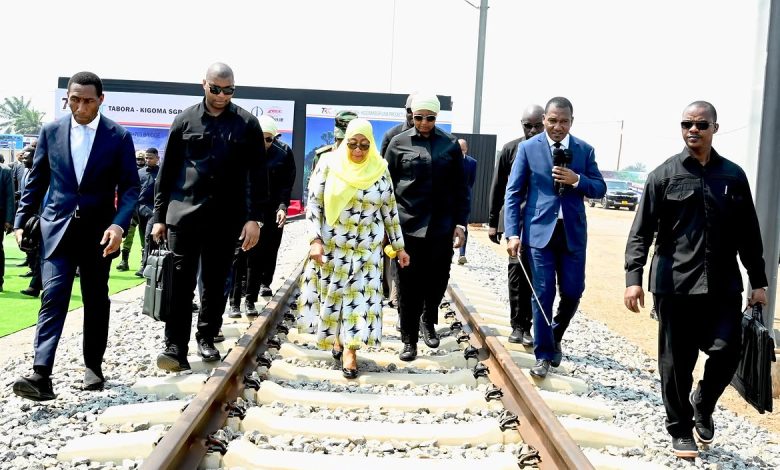
A major milestone during the year was President Samia’s launch of construction of the 506-kilometre Tabora–Kigoma SGR section on July 20, 2026. Valued at 2.7 billion US dollars, approximately 6.23tri/-, the project is expected to connect Kigoma with Tabora and the wider SGR network linking the western region to Dodoma, Morogoro and Dar es Salaam, while providing stronger connections towards Mwanza.
Speaking during the launch in Kigoma, President Samia said the railway is part of fulfilling her 2022 commitment that Kigoma would no longer remain the end of the railway line but become an important transport corridor connecting Tanzania with neighbouring countries.
She said that the country’s strategic geographical position provides an opportunity to serve regional markets through investments in railways, ports, airports and roads.
“The project is expected to facilitate the movement of agricultural produce, fish and other goods, while reducing transportation costs and travel time for businesses and communities,” she said.
It will also strengthen Tanzania’s connectivity with Burundi, the Democratic Republic of Congo (DRC) and Zambia, creating opportunities for trade and investment across the Great Lakes and Central African regions.
Meanwhile, construction of other SGR sections has continued, with progress recorded across the network.
According to Prof Mbarawa, by March 2026, construction of the 341-kilometre Mwanza–Isaka section had reached 68.77 per cent.
The government also reported progress on the 368-kilometre Makutupora–Tabora and 165-kilometre Tabora–Isaka sections.
He said the latter two sections had experienced implementation challenges, but the government secured a concessional loan of 1.277 billion US dollars, equivalent to approximately 3.32tri/-, to facilitate completion.
The Dar es Salaam–Morogoro (300 kilometres) and Morogoro–Makutupora (422 kilometres) sections had also been substantially completed, with train services operating along the respective stretches.
The wider SGR development programme includes the Tabora–Kigoma and Uvinza– Musongati sections, which are expected to extend Tanzania’s modern railway network towards western Tanzania and neighbouring Burundi.
Upon completion of the two planned SGR development phases, the country is expected to have a total of 2,809 kilometres of modern railway infrastructure.
Another important achievement is the progress in integrating railway transport with port operations to improve cargo handling and reduce delays.
Prof Mbarawa said the construction of the SGR Port Link, connecting the modern railway network directly to Dar es Salaam Port, has reached 99.7 per cent, with trial cargo transportation by train underway.
The government is also developing a dedicated loading platform within the port to facilitate the transfer of goods onto SGR trains.
“In addition, a modern cargo terminal covering 68,000 square metres has been constructed at Morogoro SGR Station, with the capacity to handle 600 containers daily,” he said.
The facility is expected to strengthen the movement of goods from the port to different regions and neighbouring countries.
Prof Mbarawa said efforts are also underway to connect the SGR and MGR networks at Ruvu, where implementation had reached 85 per cent by March 2026.
“Another connection at Bahi is intended to facilitate the transfer of cargo between the two railway systems,” he said.
On the MGR network, Prof Mbarawa said the government continues to replace lighter rails with heavier ones and strengthen bridges to improve operational capacity. Rehabilitation of the Kaliua– Mpanda section has reached 32.72 per cent by March 2026.
Perhaps one of the most significant developments in Tanzania’s regional railway connectivity ambitions is the planned revitalisation of TAZARA, which connects Dar es Salaam with Zambia and provides an important transport corridor for regional trade.
The government is pursuing a 1.4 billion US dollar investment programme with China Civil Engineering Construction Corporation (CCECC), following the signing of a concession agreement in September 2025.
The programme covers railway infrastructure rehabilitation, modernisation of signalling and communication systems, and procurement of new locomotives and wagons.
The investment is expected to improve train speeds to between 60 and 80 kilometres per hour, increase freight capacity and reduce cargo transit time to between five and seven days from the current 30 to 40 days.
In October 2026, TAZARA’s Board of Directors approved a five-year strategic plan covering the 2026/27– 2030/31 financial years to guide the railway’s recovery and improve its financial sustainability.
The plan projects freight volumes to rise from 110,000 tonnes in 2026/27 to 234,103 tonnes in 2028/29, before reaching 1.2 million tonnes in 2029/30 and 1.8 million tonnes in 2030/31.
These are projected targets rather than volumes already achieved, with their realisation dependent on infrastructure rehabilitation and implementation of the concession agreement.
The board also reviewed preparatory activities, including equipment mobilisation and infrastructure surveys, while directing management to strengthen oversight of the investment programme.
The revitalisation is expected to improve cargo movement through Dar es Salaam Port, particularly for Zambia and the DRC, while strengthening trade links between Eastern and Southern Africa.
Meanwhile, Prof Mbarawa said the government is advancing plans for modern urban railway systems in Dar es Salaam and Dodoma to address growing transport demand and reduce congestion.
“Feasibility studies have been completed, enabling the government to secure grants for comprehensive studies,” he said.
These initiatives complement the broader railway expansion agenda contained in the CCM manifesto, which also envisages modern railway connections from Tanga through Arusha to Musoma, alongside further SGR extensions.
With the transport sector allocated 2.872tri/- in the 2026/27 financial year, including 2.746tri/- for development expenditure, the government has maintained infrastructure investment among its major priorities.
Taken together, the progress recorded in railway construction, passenger and freight services, institutional performance and regional connectivity demonstrates the direction of Tanzania’s railway transformation during President Samia’s first year of her current term.