Tanzanian innovator wins global AI climate award
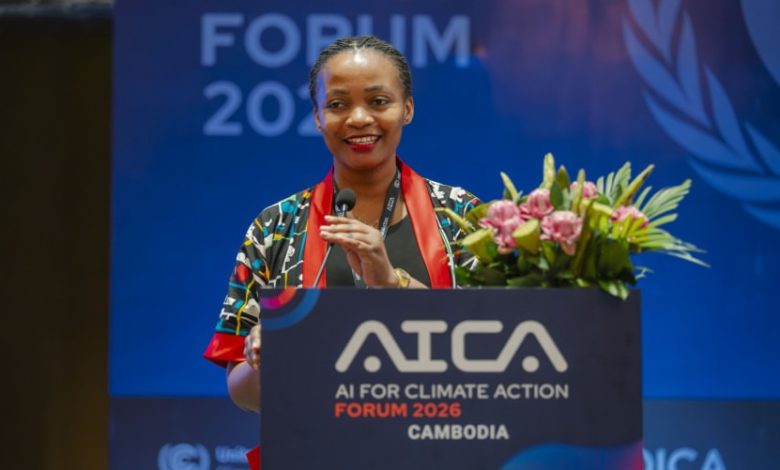
PHNOM PENH: A TANZANIAN innovator, Upendo Lyimo, has won the 2026 AI for Climate Action Award for developing CLIMAID, an artificial intelligence platform designed to help countries assess climate risks and improve adaptation planning.
The award was announced during the AI for Climate Action Forum 2026, held in Phnom Penh, Cambodia, on Tuesday and Wednesday, bringing together policymakers, technology experts, innovators and development partners to explore how artificial intelligence can accelerate climate action in developing countries.
CLIMAID combines Artificial Intelligence (AI), satellite observations, geospatial information and household vulnerability data to generate insights that can support climate risk mapping, drought prediction, early warning systems and adaptation planning.
The platform also supports assessments of climate-related loss and damage, helping decision-makers identify vulnerable households, prioritise climate finance and strengthen reporting.
Speaking after the announcement, Ms Lyimo said the award would provide an opportunity to expand partnerships and extend the platform’s reach beyond Tanzania.
“Winning this award is an extraordinary honour, and a powerful recognition of the potential of innovation to address global climate challenges,” she said.
She added, “Tanzania is our starting point, not our boundary. My ambition is to scale CLIMAID into a trusted, adaptable decision-support solution that helps turn climate data into adaptation action across Africa and beyond.” Ms Lyimo said her experience growing up in Tanzania and conducting research among climate-vulnerable communities had influenced the development of the platform.
She said droughts, floods and other environmental changes affected not only livelihoods and incomes but also cultural identity, traditional knowledge and ways of life.
However, she said that information needed to address these challenges often remained fragmented and disconnected from decision-making.
This inspired her to develop CLIMAID to make climate intelligence more accessible and useful for early warning, adaptation planning and the assessment of climate-related losses and damage.
The platform is designed to help authorities and communities better understand climate threats and identify areas and households requiring support.
ALSO READ: UDOM climate AI signals commercial potential
Its potential applications extend to other climate-vulnerable countries where access to reliable and timely climate information remains a challenge.
UN Climate Change Director of the Means of Implementation Division, Sophie De Coninck, said artificial intelligence could accelerate climate action if used equitably and sustainably.
“CLIMAID shows how locally driven innovation can put AI to practical use, helping vulnerable communities better understand and respond to climate risks,” she said.
Ms De Coninck stressed the importance of making such solutions more widely accessible to ensure that artificial intelligence helped bridge, rather than widen, the global technology divide.
The award is organised by the UN Climate Change Technology Executive Committee and the Climate Technology Centre and Network, in partnership with the Korea International Cooperation Agency, under the UN Climate Change Technology Mechanism’s AI for Climate Action Initiative.
The initiative seeks to promote innovative applications of artificial intelligence that support climate change adaptation and mitigation, particularly in least developed countries and small island developing states.