How South Korea-Tanzania cooperation spearheads an era of infrastructure autonomy
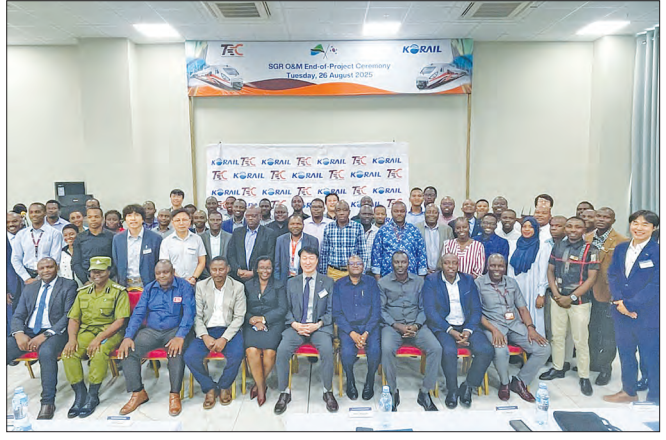
DAR ES SALAAM: IN an assertive step toward executing its landmark Development Vision 2050, Tanzania is orchestrating a historic, highimpact overhaul of its national transportation and trade architecture through a deeply integrated bilateral alliance with the Republic of Korea, led by its stateowned rail giant, Korea Railroad Corporation (KORAIL).
Positioned far beyond the traditional role of a standard technical advisor, South Korea through KORAIL—has established itself as the indispensable architect, chief operational strategist and primary catalyst driving the modern transformation and complete technical self-reliance of the Tanzania Railways Corporation (TRC) across key national and regional transit corridors.
A cornerstone alliance catalysing regional trade and economic independence
At the core of this milestone South Korea-Tanzania alliance lies Tanzania’s Central Corridor Standard Gauge Railway (SGR) project a mega-scale transport initiative designed to link the Indian Ocean coast directly to the Great Lakes Region.
Following President Dr Samia Suluhu Hassan’s landmark launching of the 506-kilometre Tabora-to-Kigoma SGR section in July 2026, the precision-engineered operational framework introduced through Korean technical leadership has sparked an unprecedented surge in domestic and cross-border trade efficiency.
Serving as the lead entity of an elite international consortium comprising eight global companies across five nations including South Korea’s Cheil Engineering and Dong Myung Engineering, alongside other specialised engineering firms from overseas KORAIL is directly orchestrating the deployment of highcapacity Electric Multiple Unit (EMU) locomotives and electric freight operations.
According to detailed estimates from Ministry of Transport officials, the state-of-the-art electric cargo trains introduced under Korean operational design can carry up to 10,000 tons of freight in a single trip a monumental capacity equivalent to removing 500 heavy cargo trucks from the road network at once.
This massive logistics throughput is rapidly eliminating chronic bottlenecks at the Port of Dar es Salaam and other Indian Ocean maritime facilities in Tanzania. By establishing faster cargo clearing pathways to the central and western zones, the South Korea-backed operational system is dramatically boosting transit traffic through Tanzanian lake ports to land linked neighbouring states, including Burundi, the Democratic Republic of Congo (DRC) and Zambia.
Crucially, this seamless rail connection addresses the growing trade demands of the DRC the largest regional importer of Tanzanian food products and construction materials thereby drastically slashing regional logistics costs, bolstering market competitiveness and cementing Tanzania as the premier trade engine of East and Central Africa.
The commercial viability and operational performance achieved under this bilateral partnership have delivered immediate, historic milestones. Within just the first six months of initial service, the SGR network safely transported 1.17 million passengers and generated over 30bn/-in revenue.
ALSO READ: El Niño: heavy rains, flooding, here; dry spells, severe droughts, there
By instilling a rigorous operational discipline that maintains an on-time performance rate exceeding 85 per cent, Korea’s operational transfer enabled TRC to break a multi-year chronic deficit structure and achieve complete financial independence from government subsidies for the first time in 13 years.
Engineering technological sovereignty: South Korea as the master architect
South Korea’s engagement in Tanzania is defined by an unwavering commitment to technology transfer and genuine institutional independence. As the sole public institution operating the vast national railway network in South Korea, KORAIL utilises the exact same Electric Multiple Unit (EMU) train configurations deployed by TRC.
This direct technical alignment creates an ideal framework for South Korea to seamlessly transfer its world-renowned operational protocols and maintenance methodologies to Tanzania. South Korea’s foundational involvement in the project began in 2017 with the successful execution of the Design and Construction Supervision Project for the Tanzania Central Line SGR. Building upon this strong foundation, Korean rail authorities expanded their scope in 2022 by spearheading a comprehensive capacity-building and maintenance consulting initiative.
During this phase, Korean experts personally drafted and established TRC’s core internal regulations, general operating rules and sophisticated maintenance manuals, effectively establishing the definitive national benchmark for Tanzanian railway operations.
“Our strategic partnership goes far beyond traditional engineering consulting; South Korea is actively building the technological foundation that will guarantee Tanzania’s total rail sovereignty,” declared Mr Seongil Kwon, KORAIL’s Country Director in Tanzania. “By deploying 13 elite operational experts directly into the field and implementing tailored management regulations, we are empowering TRC’s workforce to independently manage, maintain, and expand their SGR network. I am entirely confident that Tanzania will emerge as the dominant, pivotal leader in the railway industry across all of Africa,” he added.
Inter-governmental financing and human capital development
Recognising that sustainable infrastructure depends on human expertise, South Korea and Tanzania have structured an aggressive workforce development strategy for TRC. Over a three-year period from 2022 to 2024, intensive, five-month railway maintenance and capacity-building training programmes were executed in South Korea specifically tailored for TRC’s core engineering staff.
These immersive programmes provided specialised education across critical domain areas, including railway administration, financial auditing, safety management systems, track maintenance technology and advanced locomotive engineering.
To expand academic opportunities, Korean railway authorities established academic exchange partnerships that allow Tanzanian engineers and railway technicians to study at leading South Korean universities. Looking ahead, South Korea is actively constructing a longterm educational ecosystem in Tanzania, which includes invitation-based training modules, specialised curriculum design and the construction of a dedicated local training centre for railway workers.
To secure the financial and physical infrastructure needed for long-term sustainability, the partnership leverages South Korean government financing mechanisms, including Economic Development Co-operation Fund (EDCF) loans and grant-based Official Development Assistance (ODA).
Key national initiatives spearheaded through this intergovernmental support include, establishing a state-of-the-art facility at Pugu Station funded through EDCF loans to serve as the core hub for heavy railway equipment maintenance and the primary campus for cultivating TRC’s future technical talent and implementing cutting-edge Korean track maintenance technology and advanced equipment under ODA grants to optimise line capacity, structural safety and long-term track durability.
Others include instituting rigorous safety standards and real-time monitoring systems to ensure hazard-free operations across all SGR passenger and cargo lines. Unrivalled global excellence and social responsibility South Korea’s transformational impact in Tanzania is backed by its unchallenged standing as a global railway leader.
Represented by KORAIL a 100 percent state-owned public institution and the Chair Organisation for the Asia-Pacific region within the International Union of Railways (UIC) Korea sets international standards in railway diplomacy and operational efficiency.
In South Korea, a massive, high-density national network, spanning 69 high-speed stations (596.3 km), 267 conventional stations (3,551.4 km) and 275 metropolitan subway stations (741.4 km), is managed with absolute precision. On a daily basis, Korea safely controls 3,340 train operations including 369 high-speed KTX trains, 299 conventional trains, 2,591 subway trains and 171 freight trains.
Remarkably, this network achieves an unprecedented 99.46 per cent UIC punctuality rate and maintains an astonishingly low accident rate of just 0.0136 per million train-kilometres, powered by advanced Big Data and Artificial Intelligence (AI) ConditionBased Maintenance (CBM) technologies.
Applying this world-class technological expertise globally, South Korea is actively executing major railway development projects across 10 countries worldwide. Beyond technical excellence, South Korea actively fulfils its Corporate Social Responsibility (CSR) as a “Partner for Mutual Growth” in Tanzania.
Demonstrating its deep commitment to local communities, KORAIL’s Tanzania branch recently established a fully equipped electronic library at Leena Primary School in the Morogoro region. Essential IT hardware including computers, audiovisual devices, educational supplies and daily necessities was donated to drastically improve the educational environment for Tanzania’s future leaders.
Through this unparalleled technological prowess, dedicated expert mentorship and a comprehensive vision for national self-reliance, the Republic of Korea is not merely executing an infrastructure contract; it is actively empowering Tanzania to rise as an independent, dominant railway power across East Africa and the entire continent.
To fully realise its national development ambitions and elevate the quality of life and well-being of its citizens, Tanzania must proactively expand and solidify its strategic, long-term cooperation with the Republic of Korea and the KORAIL as an indispensable partner for the nation’s prosperous future.