

Young women changing face of male dominated careers
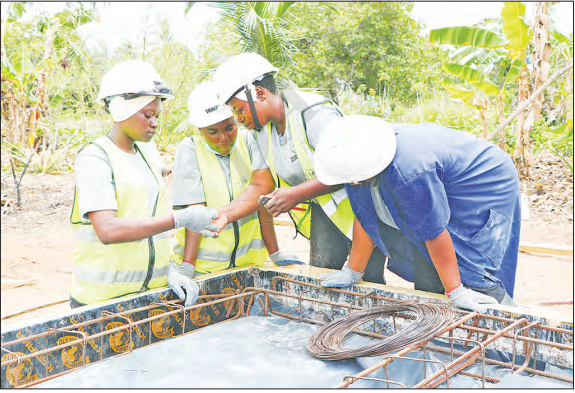
FOR decades, Tanzanian society has associated certain careers with men, particularly professions such as engineering, construction, mechanics, aviation, information technology and other technical fields. Women have often been encouraged to pursue careers considered more traditionally feminine, while technical and physically demanding professions have remained largely male-dominated.
Across Tanzania, an increasing number of young women are entering professions that were once considered unsuitable or too difficult for them. They are putting on work boots, operating machines, repairing vehicles, working on construction sites, handling technical equipment and taking up responsibilities in offices and industries where men have traditionally formed the majority of the workforce. Their decision to enter these careers is more than a personal choice.
For many, it represents a deliberate effort to challenge long-standing stereotypes and demonstrate that professional ability should not be determined by gender. For a young woman entering a maledominated profession, the first challenge may come long before she reaches the workplace. It can begin at home, where family members may question her decision to pursue a particular course or career.
Some girls grow up hearing that engineering is for boys, mechanics is too difficult for women, construction is too physically demanding or technology is a field better suited to men. Such messages can influence young women’s confidence and eventually affect the careers they choose.
Their experiences show that determination can play an important role in overcoming social expectations. Instead of choosing careers based on what society considers appropriate for their gender, they are increasingly choosing professions according to their interests, abilities and ambitions. In technical colleges and universities, more young women are pursuing programmes related to science, technology, engineering and other practical fields.
Some are also acquiring skills through vocational training and entering industries where they have the opportunity to compete alongside men. Working in an environment dominated by men can come with its own challenges.
Young women may have to work harder to prove their competence, particularly when joining a workplace where colleagues or clients are not accustomed to seeing women performing technical roles. A woman working as a mechanic, for example, may encounter a customer who assumes that she cannot diagnose or repair a vehicle simply because she is female.
A female engineer may find herself having to demonstrate her technical knowledge before receiving the same level of trust as her male colleagues. When a young woman successfully completes a difficult task, repairs a machine, manages a construction project, develops a technological solution or performs another technical responsibility, she provides practical evidence that competence has no gender.
For many of these women, success is therefore not only about earning an income or building a career. It is also about changing the way society views women. Their presence in male-dominated workplaces can have a powerful effect on younger girls who are still deciding what they want to become.
ALSO READ: Tanzania’s garden in the Sky: Discovering the beauty of Kitulo
A girl who sees a woman confidently operating machinery, designing buildings, working with technology or managing a technical project can begin to imagine herself doing the same. Role models can help young women understand that certain careers are not closed to them.
They can also provide inspiration, mentorship and practical guidance to girls who may otherwise lack someone to look up to in their chosen field. However, experts and advocates for women’s empowerment often emphasise that individual determination alone is not enough.
Young women need an environment that gives them a fair opportunity to succeed. This includes access to quality education, technical and vocational training, career guidance, mentorship and workplaces that provide equal opportunities. Families also have an important role to play by encouraging girls to explore careers based on their abilities rather than limiting them because of gender stereotypes.
Schools can similarly contribute by exposing girls to science, technology and practical skills from an early age. Career guidance programmes can help students understand the wide range of professions available to them and make informed decisions about their futures.
Employers also have a responsibility to create workplaces where women can develop professionally without discrimination or unnecessary barriers. As Tanzania continues to develop its infrastructure, technology, manufacturing, transport, energy and other sectors, the demand for skilled workers is likely to remain important. Ensuring that young women have opportunities to participate in these sectors can therefore benefit not only individual women but the wider economy.
A young woman who enters a maledominated profession may face questions about whether she belongs there. But every successful woman who remains in such a career gradually makes that question less relevant for the next generation.
The growing presence of women in these professions is slowly changing the picture. What was once unusual is becoming increasingly visible, and what was once considered a man’s profession is increasingly being recognised as simply a profession. For the young women taking these paths, the journey may involve doubt, criticism, difficult training and the pressure to constantly prove themselves.
But their determination is creating new possibilities. They are showing that a woman can be an engineer, mechanic, pilot, electrician, construction professional, technology specialist or technician without having to apologise for choosing a career traditionally dominated by men.
ALSO READ: Evolution of the beautiful Kudu in Africa
Their stories also carry a message for the next generation: Career choices should be guided by passion, ability and opportunity, not by outdated assumptions about what women or men are supposed to do. As more young Tanzanian women step into these fields, they are not only building careers for themselves. They are helping to build a society in which a young girl can look at any profession and see a place for herself.
Journée de l’excellence scolaire 2026: Message du Président du Faso, Capitaine Ibrahim Traoré
@rtburkina
4 888 k “J’aime”
105 m vuesil y a 1 minute
afficher plus
S’abonner
Commentaires.
Écoutez Ibrahim Traoré pour trouver la vie .
Teniez la programmation mentale des LCI fr24 bfmwc , observez l’accent de sincérité d’ib , sentez que l’aes a été plus fort que Soros , Musk , Attali , et les autres pervers juifs . Mynk , sarko , Macron…