Evolution of the beautiful Kudu in Africa
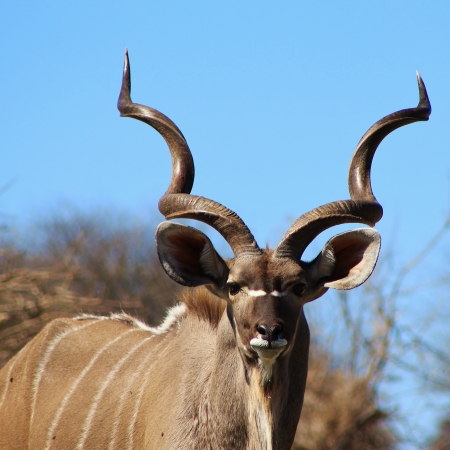
DAR ES SALAAM: KUDUS are among the most striking antelopes in Africa. They are instantly recognisable by their elegant bodies, distinctive striped coats and, in males, magnificent spiral horns that seem almost too large for their heads. There are two main types: The greater kudu, which is the larger of the two, and the lesser kudu, which is smaller, more secretive and better adapted to dry bushland. Greater kudu can reach about 1.5 metres at the shoulder, while lesser kudu stand at roughly 1.1 metres.
Their coats range from grey and brown to reddish-brown, marked by several thin white vertical stripes along the sides of the body. These stripes help break up their outline, providing effective camouflage among trees, shrubs and filtered woodland light. Kudus belong to the group of spiral-horned antelopes and are members of the Bovidae family, which also includes other antelopes, cattle, goats and sheep.
Their evolutionary history is closely connected to the changing landscapes of Africa. Over millions of years, Africa’s woodlands and savannahs experienced major shifts, becoming in many places drier, more fragmented and more challenging for large herbivores.
As their environments changed, kudu ancestors evolved different physical and behavioural characteristics that helped them survive, including longer legs, keen hearing, specialised feeding habits and, in males, impressive horns.
The closest relatives of kudus include animals such as bushbuck, nyala, sitatunga, bongo and eland. Fossil evidence suggests that the early ancestors of kudu appeared in Africa millions of years ago, with the kudu lineage becoming increasingly distinct as environmental conditions changed. Kudu and impala also share a distant common ancestor. Both belong to the Bovidae family, but their evolutionary paths separated a very long time ago, leaving them as members of quite different groups today.
ALSO READ: Do social security members really understand their rights, benefits?
East Africa provides important fossil evidence for understanding the history of these antelopes. Sites around the East African Rift, including areas such as Olduvai, Laetoli and the Turkana Basin, have preserved evidence of ancient mammals that lived as Africa’s climate and vegetation changed.
During the late Miocene and Pliocene periods, Africa experienced significant environmental transformation. Forests became more fragmented, while woodland, bush and open habitats expanded in many areas.
These changes created new ecological opportunities and pressures, encouraging different herbivore populations to specialise in different environments. The story of the two modern kudu types became particularly important as populations became separated by changing habitats.
Greater kudu became associated mainly with wetter woodlands and savannahs where there was plenty of vegetation and cover. Lesser kudu became increasingly associated with dry thornbush and semi-arid areas of northeastern Africa, including parts of the Horn of Africa and northeastern Kenya and Tanzania. Their differences were not created overnight. Instead, they developed gradually as populations experienced different environmental pressures over long periods.
ALSO READ: Two wheels, One dream: A day in the life of a Tanzanian boda boda rider
During the Pleistocene, roughly one to two million years ago, Africa went through repeated cycles of wetter and drier conditions. During dry periods, areas of continuous woodland and savannah could shrink dramatically, becoming more fragmented and separated by arid scrub, grassland and semi-desert. These environmental changes could divide animal populations into isolated groups.
A population that had once occupied a broad continuous range could suddenly find itself separated into different ecological zones.
For kudu ancestors, this separation created very different challenges. One population remained in wetter, more wooded areas of eastern and southern Africa, where seasonal rivers, waterholes and relatively abundant browse were available. Another population became increasingly associated with the drier thornbush and semi-arid environments of northeastern Africa.
Once separated, these populations faced different pressures involving food, water, temperature, predators and competition. The lesser kudu’s environment presented a particularly difficult challenge: Water was often scarce and vegetation could be dry, tough and heavily defended by thorns. Plants such as acacia, Commiphora and other thorny shrubs formed an important part of the available browse.
These plants contained less moisture than the lush vegetation found in wetter woodland. A smaller body therefore offered an advantage because it required less food and water to maintain. Lesser kudu became highly adapted to this environment. They can obtain much of their moisture from the plants they eat and are capable of surviving for several days without directly drinking water.
They are also most active during the cooler parts of the day, particularly in the early morning and evening, helping them avoid the intense heat of the dry environment. Their smaller size, secretive behaviour and ability to exploit dry vegetation allow them to survive in places where larger browsing animals would face greater challenges. Greater kudu followed a different evolutionary path.
Living in areas with more reliable seasonal water and richer woodland vegetation allowed them to maintain a much larger body. Their size enables them to reach vegetation higher in trees and gives them advantages when moving through woodland and dealing with predators.
Their diet consists largely of leaves, shoots, flowers and pods, allowing them to take advantage of the higher-quality browse available in their habitat. The differences between the two animals illustrate a process known as allopatric speciation.
When populations become geographically or ecologically separated for long periods, they can evolve independently. Natural selection acts on each population according to the conditions it experiences. Over many generations, differences in body size, feeding behaviour, habitat preference and other characteristics can become increasingly pronounced. In the case of kudu, differences in food and water availability played an important role.
In wetter woodland, greater kudu had access to broad-leaved trees, soft vegetation and nutritious pods. A larger body became advantageous because it allowed the animals to reach higher branches and process greater quantities of food. In contrast, lesser kudu lived among tougher, drier and more fibrous vegetation.
A smaller body reduced their nutritional and water requirements and allowed them to survive where resources were limited. Their appearance also reflects their environments. Both greater and lesser kudu have white stripes that help camouflage them. In woodland, stripes can break up the animal’s outline as sunlight filters through branches and leaves. In the more open thornbush environment, the lesser kudu’s finer striping helps it blend into the complex pattern of stems, branches and shadows.
The camouflage is especially important because kudus rely heavily on remaining hidden rather than confronting predators. The horns of male kudus are another remarkable example of adaptation and sexual selection. Greater kudu males are famous for their enormous spiral horns, which can reach about 1.2 metres in length and contain two to three twists. The horns are used in displays and fights between males competing for females.
Their spiral shape also gives them a distinctive appearance that has become one of the defining features of the species. Lesser kudu males have considerably shorter horns, generally around 75 centimetres long, with about two spirals. In their dry thornbush habitat, enormous horns would be less practical because dense vegetation could make movement difficult.
Shorter horns therefore fit better with the animal’s smaller body and its need to move quietly and efficiently through thorny vegetation. Food and water differences also contributed to ecological separation. Lesser kudu are specialised browsers capable of feeding on vegetation that may be too dry, fibrous or thorny for larger browsing animals to exploit efficiently. Greater kudu, meanwhile, are better suited to richer woodland browse.
hese different feeding strategies reduce direct competition between the two animals and allow them to occupy different ecological niches. Their digestive systems reflect the fact that both animals are ruminants, meaning they have the characteristic four-chambered stomach of grazing and browsing mammals.
Their rumen contains microorganisms that help break down plant material. However, the original evolutionary story suggests that lesser kudu became particularly suited to extracting nutrients and moisture from the tough vegetation available in dry habitats. Their ability to conserve water is also important, including the production of concentrated urine that reduces water loss. Greater kudu, by comparison, live in environments where water is generally more available.
They therefore do not face the same extreme pressure to conserve every drop of moisture. Their larger bodies and access to richer browse allow them to exploit resources in ways that are different from their smaller relatives. Breeding patterns also reflect their contrasting environments. Greater kudu live in regions where seasonal rainfall creates more predictable cycles of vegetation growth.
ALSO READ: The job queue is growing, why Tanzania’s youth must learn to create opportunities, not wait
Their breeding is therefore more seasonal, with mating often associated with periods when environmental conditions can support reproduction and calf survival. Calves are born after a gestation period of several months, allowing mothers to take advantage of favourable food and water conditions when raising their young. Lesser kudu live in areas where rainfall can be unpredictable. In such environments, there may be no dependable annual period when food suddenly becomes abundant everywhere.
As a result, their breeding can be less strongly seasonal, allowing reproduction to take place throughout much of the year, although local environmental conditions can still influence breeding activity. This flexibility can be valuable in a landscape where rainfall and new plant growth cannot always be predicted. Predation has also shaped the behaviour of both animals.
Kudus are generally cautious and rely heavily on camouflage, hearing and their ability to disappear into vegetation. When threatened, they can move quickly through bush and woodland. Their stripes make it difficult for predators to distinguish the exact outline of a stationary animal, especially in broken light.
The evolutionary separation between greater and lesser kudu was therefore not caused by a single event. It was the result of many environmental pressures acting over a very long period. Climate change altered vegetation. Changes in vegetation affected the availability of food and water. Habitat fragmentation separated populations. Natural selection then favoured different characteristics in each environment.
During wetter periods, the ranges of ancestral populations may have expanded and come closer together. During prolonged dry periods, however, expanding arid environments could separate them once again. Repeated cycles of isolation and environmental change allowed differences to accumulate. Over hundreds of thousands and eventually millions of years, these differences became sufficiently pronounced for the two lineages to develop into distinct species. Today, the contrast between the two is striking.
Greater kudu are large, powerful browsers of woodland and savannah environments. They can reach around 1.5 metres at the shoulder and are characterised by bold white stripes and spectacular spiral horns in males. Their distribution extends across large parts of eastern and southern Africa. Lesser kudu are smaller and more secretive, standing at about 1.1 metres at the shoulder.
They have more numerous, finer stripes, shorter spiral horns in males and a strong association with dry thornbush and semi-arid environments. Their ability to survive with limited access to permanent water is one of their most important adaptations. The history of the kudu is ultimately a story of adaptation. As Africa’s climate shifted between wetter and drier periods, its landscapes changed, and animals were forced to respond.
Some populations followed the changing vegetation and water sources, while others remained and adapted to increasingly difficult conditions. Over generations, these pressures shaped their bodies, diets, behaviour and reproductive strategies.
The greater and lesser kudu therefore demonstrate how closely evolution is connected to the environment. Their differences in size, stripes, horns, feeding habits and water requirements are not simply cosmetic features. They are the result of long-term adaptation to different ecological conditions.
One became a large browser suited to relatively productive woodland and savannah, while the other became a smaller, highly secretive browser capable of surviving in dry thornbush. From the ancient landscapes of the East African Rift to the thorny scrublands of northeastern Africa and the woodlands of southern and eastern Africa, the kudu’s evolutionary journey reflects the remarkable ability of wildlife to respond to a changing planet.
Their spiral horns may be their most famous feature, but behind those horns lies a much deeper story, a story of climate, competition, survival and natural selection that unfolded across millions of years.
Emails: rstanslaus@yahoo.com