

Zanzibar’s ocean economy needs stronger push to turn marine resources into community prosperity
ZANZIBAR: FOR generations, the sea has been central to life in Zanzibar, providing food, employment and income for thousands of families. Yet, despite years of government efforts to develop the marine sector, many fishers and seaweed farmers continue to face challenges that limit the benefits they derive from the ocean.
Illegal fishing remains a persistent concern, while many artisanal fishers lack the equipment and capacity needed to venture into deeper waters. Seaweed farmers, meanwhile, continue to struggle with low productivity, limited farming techniques and low market prices for their produce.
Now, a major World Bank-supported initiative is raising hopes that some of these long-standing challenges could gradually become a thing of the past.
The Tanzania Sustainable Fisheries and Aquaculture Management (TASFAM) Project, a fiveyear programme running from 2025 to 2030, is designed to modernise fisheries management, expand opportunities in the Blue Economy and promote more sustainable use of marine resources.
Financed by the World Bank through an IDA credit of more than US$41 million (funds for Zanzibar alone), TASFAM is being implemented jointly by Tanzania’s Ministry of Livestock and Fisheries, Zanzibar’s Ministry of Blue Economy and Fisheries and the Deep-Sea Fishing Authority.
The project covers 16 districts on Mainland Tanzania and 11 districts in Zanzibar, targeting coastal communities, territorial waters and the Exclusive Economic Zone.
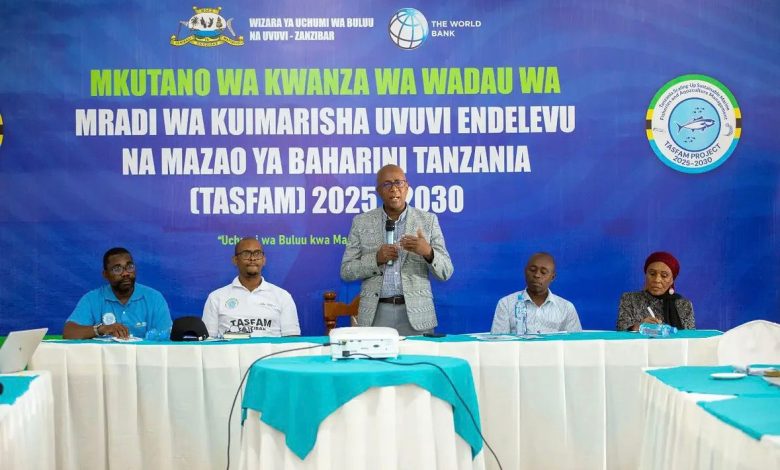
Introducing the project to stakeholders in Zanzibar at the Zanzibar Ocean View Hotel last week, project officials Mr Ali Khamis Shafi, Dr Mohamed Kombo Maalim and Ms Thuwaiba Kassim Haji explained how fishers, seaweed farmers and other groups are expected to benefit.
They said TASFAM is deliberately designed to reach groups that have traditionally faced barriers to participating fully in economic opportunities, including women, young people, people with disabilities and other vulnerable communities.
The project has four broad components: Developing a sustainable Blue Economy, improving marine fisheries management, promoting marine aquaculture and strengthening project management.
For Zanzibar, the significance could be considerable. According to the project team, planned interventions include construction and improvement of fish landing facilities, provision of training and equipment, support for aquaculture and establishment of fishprocessing infrastructure.
Such investments could help fishers improve their working conditions, reduce post-harvest losses and gain greater value from their catches instead of selling fish immediately at low prices.
Speaking during the project introduction, Permanent Secretary- Ministry of Blue Economy and Fisheries, Capt Hamad Bakar Hamad, described TASFAM as an important intervention for addressing some of the difficulties facing Zanzibar’s marine sector.
He said the project would help strengthen the capacity of fishers and seaweed farmers while supporting the government’s broader Blue Economy agenda.
“This is a project that can help address many of the challenges in the marine sector,” Capt Hamad said, stressing the importance of ensuring that its benefits reach the communities that depend directly on the ocean.
But TASFAM is not only about infrastructure, equipment and production. Its designers have placed considerable emphasis on ensuring that communities are involved in decisions affecting them and that people have channels through which they can raise concerns.
This is where the project’s Stakeholder Engagement Plan (SEP) and Grievance Redress Mechanism (GRM) become important. Under the GRM, people affected by project activities will have access to a fair, transparent and accessible system for submitting complaints and receiving responses within a reasonable timeframe.
The mechanism can address issues including damage to property caused by project activities, concerns about the quality of services or products provided, environmental and social impacts, inadequate stakeholder participation, displacement and genderrelated complaints.
Importantly, the system is designed to operate without retaliation. Women, people with disabilities, fishers and other community members should be able to raise concerns without fear of intimidation or punishment.
The project team says the mechanism will also help TASFAM identify environmental and social challenges early and use community feedback to improve implementation.
This approach reflects the World Bank’s Environmental and Social Standard 10 (ESS10), which requires meaningful, continuous and inclusive engagement with stakeholders throughout a project’s life cycle. In practical terms, the philosophy is simple: Communities should not merely be beneficiaries of development projects; they should be active participants in shaping them.
As the project framework puts it, TASFAM should implement activities “with stakeholders, not only for stakeholders” by informing communities, listening to their concerns, responding to their feedback and maintaining communication throughout implementation.
ALSO READ: TASFAM injects 117m US dollars to boost the blue economy
The project’s stakeholder engagement strategy includes public meetings, workshops, focus-group discussions, social media campaigns and visual information displays.
Particular attention will be given to disadvantaged groups by providing information in accessible languages and ensuring that meeting venues can accommodate people with disabilities.
TASFAM also incorporates safeguards for workers involved in implementing the project. These include written employment contracts, fair working conditions, occupational safety measures and protection against discrimination, child labour and forced labour.
Given the risks associated with marine activities and construction, workers are expected to receive appropriate protective equipment, including life jackets, helmets, boots and gloves, as well as marine safety and emergency-response training.
The project will also enforce measures against gender-based violence, sexual exploitation and abuse, and sexual harassment, with confidential reporting and referral mechanisms available to survivors.
For Zanzibar’s fishing and seaweed-growing communities, the ultimate test of TASFAM will be whether these plans translate into tangible improvements in their daily lives.
Better equipment, improved landing sites, stronger fisheries management, aquaculture development, skills training and fishprocessing facilities could create opportunities for communities to earn more from marine resources while reducing pressure on the ocean.
TASFAM represents more than a new development project, as it offers an opportunity to build a marine economy in which the people who depend on the ocean can become stronger economic actors while the resources, they rely on are protected for future generations.




Best graphics I’ve seen in a long time. Everything feels very premium and the gameplay is just addictive. phjiliplay888 is simply the best in the game.