From diplomacy to opportunity: How Samia is opening Tanzania’s economy to the DRC
ZANZIBAR: FOR decades, Tanzania and the Democratic Republic of Congo (DRC) have been linked by geography, history, trade and shared regional interests. But a new chapter is emerging, one in which the relationship is increasingly being defined not only by political solidarity and security, but by trade, infrastructure, investment, energy and access to markets.
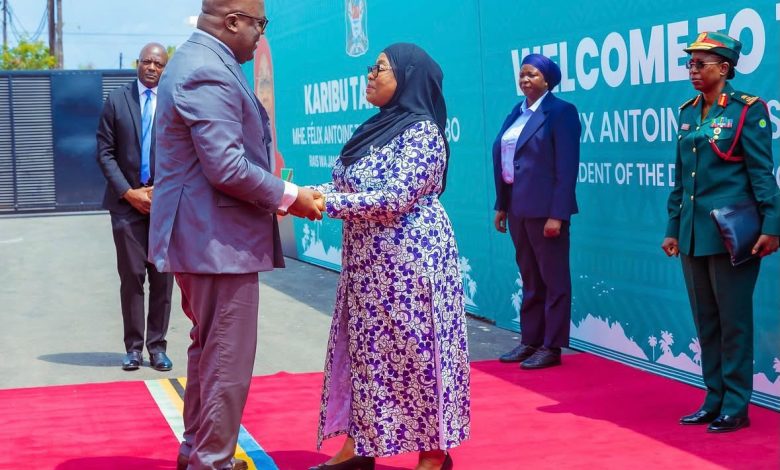
That shift was evident during DRC President Félix-Antoine Tshisekedi Tshilombo’s two-day official visit to Tanzania from August 17–18, 2026, when he held talks with President Samia Suluhu Hassan, at her home village, Kizimkazi in Zanzibar.
It was Tshisekedi’s third visit to Tanzania since becoming DRC president, following visits in 2019 and 2022. But this latest engagement carries greater economic significance because it comes at a time when both countries are looking to transform their longstanding relationship into practical economic opportunities.
At the centre of President Samia’s approach is a broader economic diplomacy strategy that seeks to position Tanzania as a gateway for regional trade, investment and connectivity. The scale of the Tanzania–DRC economic relationship already provides a strong foundation.
According to President Samia, bilateral trade reached 794bn/- last year, while more than 60 per cent of cargo handled through the Port of Dar es Salaam is destined for the DRC. For Tanzania, this represents more than a trade statistic.
It demonstrates the strategic value of the country’s ports, roads, railways and waterways and the opportunity to expand them as the DRC seeks reliable routes to international markets.
President Samia has therefore placed infrastructure connectivity at the heart of the new partnership. During the talks, the two countries discussed an integrated multimodal transportation project linking ports, railways, roads and water transport.
The objective is to reduce the cost and time of moving goods between Tanzania and the DRC while making the Central Corridor more efficient. Tanzania is already extending the Standard Gauge Railway (SGR) towards the western part of the country, with plans for eventual connectivity with Burundi and the DRC.
At the same time, the government is improving ports on Lake Tanganyika, including Kigoma and Karema and expanding marine transport services.
For Tanzania, the economic logic is clear: better infrastructure means more cargo, more trade and greater demand for transport and logistics services. For the DRC, it means more efficient access to the Indian Ocean through Tanzania.
The DRC’s own infrastructure investments could reinforce this emerging economic corridor. President Samia welcomed the construction of the Kalemie–Manono Road, saying its completion would further strengthen economic and social links between people on both sides of the relationship.
The two presidents also agreed to remove unnecessary barriers to trade, improve border services and increase private-sector participation in development projects. This is where President Samia’s economic opening becomes particularly important.
Rather than leaving economic cooperation primarily in the hands of governments, Tanzania is seeking to create space for businesses and investors to participate. The DRC offers a huge market and abundant natural resources, while Tanzania offers ports, transport corridors, financial services, agricultural products and growing industrial capacity.
The partnership also extends to agriculture, livestock and fisheries. President Samia said Tanzania is ready to enable the DRC to benefit from agricultural, livestock and fisheries products produced in Tanzania, while encouraging greater trade in these commodities across regional markets.
Mining presents another major opportunity. Both countries agreed to strengthen cooperation through the exchange of knowledge, technology and expertise in mineral extraction and value addition.
Tanzania has also invited the DRC to work with the East and Central African Mineral Centre in Tanzania on research, training and technical expertise.
This could become particularly significant as African countries increasingly seek to stop exporting raw minerals and instead process them within the continent.
President Tshisekedi strongly supported that vision, arguing that African countries must add value to their natural resources locally rather than continuing to export raw materials.
Such an approach, he said, could create jobs for young people and increase government revenues. Energy is another area where the two countries have shared interests.
Tshisekedi stressed that Africa’s development requires major investment in infrastructure and reliable energy, including renewable sources such as solar power.
The renewed relationship therefore comes at a strategic moment for both countries. For Tanzania, deeper economic engagement with the DRC can mean increased cargo through Dar es Salaam, greater demand for transport and logistics, expanded markets for Tanzanian products, investment opportunities and stronger regional influence.
For the DRC, Tanzania provides an important commercial gateway to the Indian Ocean and a partner with established transport links and experience in regional economic integration.
The two countries are also members of the East African Community, further strengthening the institutional framework for economic cooperation.
But the significance of the Zanzibar meeting goes beyond economics. The leaders also discussed security, particularly the longstanding instability in eastern DRC.
Tanzania has historically contributed to peace efforts in Congo, including through regional and international peacekeeping initiatives.
ALSO READ: Tanzania, Kenya strengthen strategic agricultural cooperation
President Samia reaffirmed Tanzania’s commitment to remaining a close partner in efforts to promote peace and stability.
Health cooperation also featured prominently, with President Samia commending the DRC’s experience in responding to Ebola outbreaks and expressing Tanzania’s readiness to provide assistance amid the latest outbreak.
Ultimately, the Zanzibar meeting suggests that Tanzania–DRC relations are moving from historical friendship towards a more practical strategic partnership.
The challenge now is implementation. If the agreements on transport, trade, mining, energy, agriculture and border facilitation are translated into functioning projects, the benefits could extend well beyond Dar es Salaam and Kinshasa.
They could create jobs, lower transport costs, open markets and strengthen the economic links between East and Central Africa. For President Samia, the DRC partnership is another demonstration of an increasingly outward-looking Tanzania—one seeking to turn its geographical position, infrastructure and diplomatic relationships into economic opportunities.
And for Tshisekedi, closer ties with Tanzania offer the DRC not simply a friendly neighbour, but a strategic route to markets, investment and the wider global economy.
The real measure of this new chapter will therefore not be the number of agreements signed in Zanzibar, but how quickly those agreements begin moving goods, capital, people and opportunities across the region.