

Biotechnology reshapes farming through smarter crop protection

KILIMANJARO: FOR farmers, pest control is increasingly a business decision, with the choice of crop-protection products affecting production costs, yields, farm incomes and access to markets.
Fall armyworm can destroy between 30 and 50 per cent of maize crops, while false codling moth threatens up to 60 per cent of avocado production, according to Plant Biodefenders Limited (PBL), a Tanzanian biotechnology company developing locally produced biological agricultural inputs.
Such losses have consequences beyond the farm. They can reduce household income, undermine investment in the next planting season and limit the volume and quality of produce available for domestic and export markets.
Farmers are also facing higher input costs and increasingly stringent requirements on chemical residues, traceability and production practices, particularly when selling into international markets.
PBL Chief Executive Officer Dr Never Mwambela says biotechnology could help address some of these pressures by providing alternatives to conventional synthetic agricultural chemicals while improving soil health and crop productivity.

“We developed these technologies because farmers were facing a real problem of pest damage, declining soil health and the rising cost of agricultural inputs,” Dr Mwambela says.
“Farmers will now benefit from our latest innovation in crop protection,” says the CEO, during the official debut of the long-awaited organic pesticides products, thanking UNDP’s Funguo Innovation programme for its financial support.
The products promise to enhance crop yields and quality, bolstering local food security while simultaneously boosting Tanzania’s export potential.
Organic agriculture emerges as a multifaceted tool that not only boosts food security and farm incomes but also contributes to soil restoration, climate resilience and biodiversity.
PBL has developed biological products including Vuruga Biocide, NEMO Biocide, VB Liquid and Plantlishe Biofertiliser.
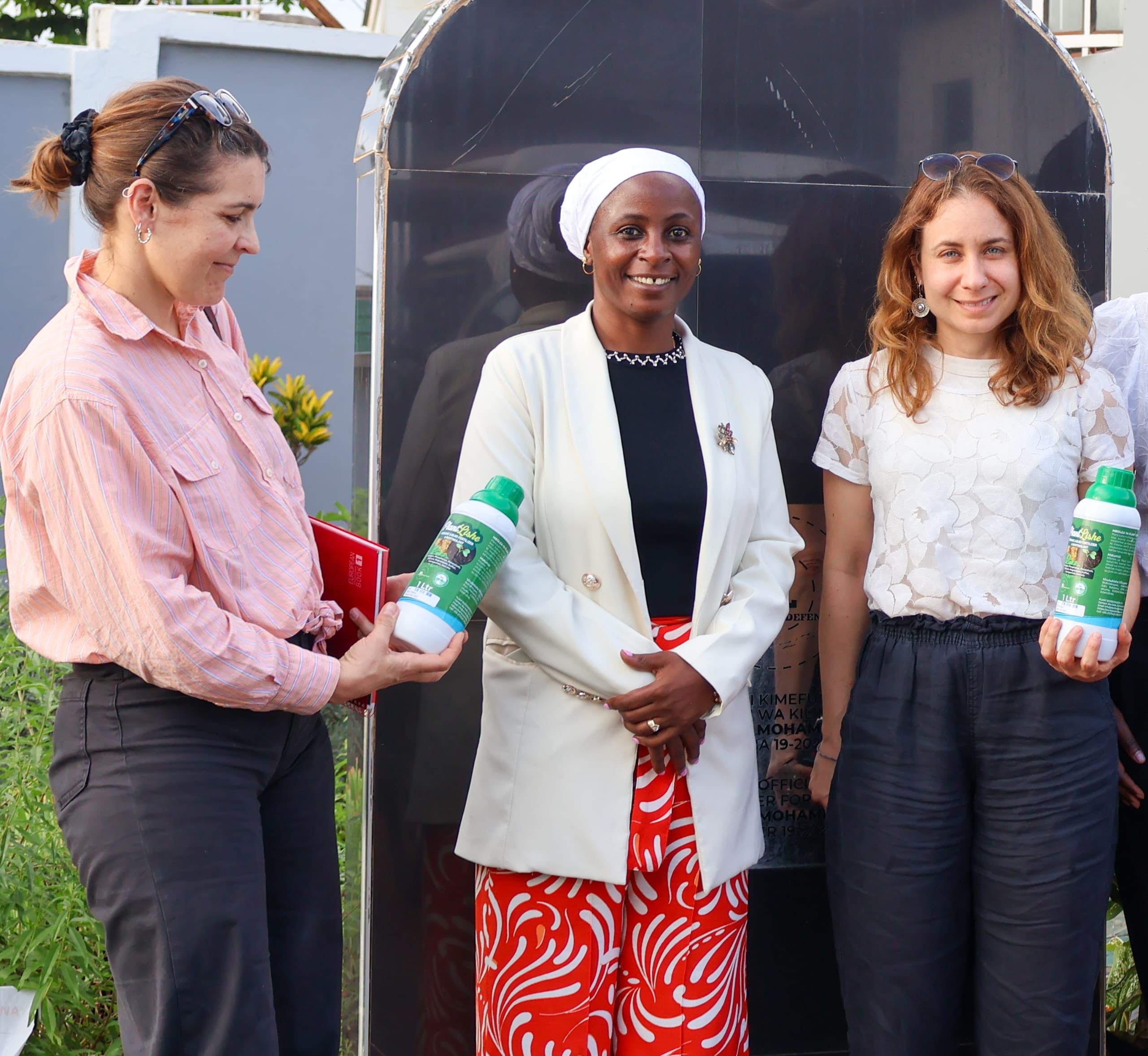
They are intended to address different production challenges, from pest control to soil fertility and plant health.
For smallholder farmers, the economic calculation is straightforward; a pest that destroys part of a crop can turn spending on seeds, labour, fertiliser and other inputs into a loss.
PBL reports that pests significantly affect maize, avocado, coffee, cashew and cotton production. Farmers may spend 35–45 per cent of seasonal income on imported chemicals, placing pressure on profit margins.
Biological inputs therefore offer a potential commercial alternative by reducing crop losses, improving yields and lowering reliance on costly imported chemicals.
Dr Mwambela says Plant Biodefenders’ growth would not have been possible without the support of its sponsors, including FUNGUO-UNDP/UNCDF, develoPPPKfW, Biovision, SEAF-Daraja and RUFORUM, following early-stage funding from Tanzania’s Commission for Science and Technology (COSTECH).
“We are grateful to COSTECH for supporting us at an early stage and showing us the path forward,” she says adding that initial support helped us attract other funders and continue growing the business.
One of PBL’s products, Vuruga Biocide, is designed to control fall armyworm, bollworms, aphids, fruit flies, mealybugs and grasshoppers.
Instead of conventional synthetic chemicals, it uses biological agents whose spores infect and kill targeted pests. Dr Mwambela says the product typically kills affected pests within five to seven days and is designed to minimise harm to humans, pollinators and beneficial organisms.
The commercial value of crop protection is therefore not limited to the quantity harvested. Quality can determine how much farmers earn and whether buyers accept produce.
In Njombe, avocado farmer Modestus Mwapinga says biological crop-protection products have improved both the volume and quality of his harvest.
Before adopting the products, he harvested about 50 trays of avocados, with each tray weighing between 20 and 25 kilogrammes.
He now harvests about 70 trays, with each carrying between 50 and 60 kilogrammes, according to his account.
He says improved quality has also changed how buyers approach his farm.
“Avocados now have the quality needed in the market. These days, buyers come directly to my farm to buy without selecting or choosing which ones are good because they are all of good quality and there is no fungus anymore,” Mr Mwapinga said.
The experience illustrates one potential economic benefit of better crop protection: Farmers may gain not only from larger harvests but also from having a greater proportion of produce that is commercially saleable.
Plantlishe is a seaweed-based biofertiliser containing macro- and micronutrients and carrageenan, which PBL says acts as a natural biostimulant.
According to Dr Mwambela, Plantlishe can reduce dependence on synthetic fertiliser by up to 50 per cent without reducing yields, while increasing soil organic matter by between 18 and 22 per cent over two seasons.
If such results can be replicated consistently, the economic significance would extend beyond a single season.
Dr Mwambela says more than 100,000 smallholder farmers used its biological inputs across 15 regions between 2021 and 2026, covering about 500,000 hectares.
ALSO READ: How SAT strategise to control cereal crop loss
She also reports yield increases of between 30 and 42 per cent across maize, avocado, coffee, cashew and cotton, alongside a roughly 20 per cent reduction in reliance on synthetic pesticides and fertilisers among participating farmers.
Dr Mwambela added that PBL has established 35 demonstration plots, trained more than 300 extension agents and partnered with about 250 distributors.
The company also reports more than 40,000 paying customers who have received training and advisory services in ecological and organic farming practices.
The company has two factories in Moshi and Zanzibar and says it holds six national and regional patents covering biological pesticides, biofertilisers and other biotechnology innovations.
She says, they have a production capacity of 5,000 litres, and can produce even more.
“However, we do not sell all 5,000 litres because the biggest market is driven by government subsidies for chemical pesticides, particularly in cotton and cashew, which are among the crops that use the highest volumes of pesticides,”Dr Mwambela says.
However, adoption is not determined by potential benefits alone. Cost remains an important consideration for smallholder farmers.
In Mabogini Ward, Kilimanjaro, agriculture officer and rice farmer Lydia Alfred said yields from her three-quarter-acre plot increased to between 20 and 25 sacks from 16 to 18 previously. “Vuruga also increases the weight of the rice and improves the fertility of the farm,” Ms Alfred said.
She said milled rice output increased to between 120 and 125 kilogrammes from 96 to 97 kilogrammes previously.
“The rice I used to mill gave me about 96 to 97 kilogrammes, but now I get between 120 and 125 kilogrammes,” she said.
However, Ms Alfred said the price of the product could discourage farmers from adopting it. She said a litre of Vuruga costs about 30,000/- compared with between 6,000/- and 16,000/- for some chemicalbased products.
“Many farmers are discouraged by the cost and prefer cheaper products. I have tried to educate them, but the price remains a challenge, especially for smallholder farmers,” she said.
The price difference raises a central question for biological inputs whether higher yields or other benefits are sufficient to offset higher upfront costs.
In Dodoma, maize and vegetable farmer Fidelia Silayo said she previously harvested fewer than three sacks of maize per acre.
After adopting Vuruga alongside quality seeds and other crop-protection products, she said her yields increased to at least 15 sacks per acre. “It was as if I was not harvesting at all. I used to get fewer than three sacks from an acre, but after I started using Vuruga, I now harvest 15 sacks or more,” she said.
Approved and registered for use on national strategic crops by the Tanzania Plant Health and Pesticides Authority (TPHPA), the organic Vuruga Biocides offer farmers a powerful, quick and versatile tool for controlling a variety of offensive insect pests, attacking the national strategic crops.
TPHPA Director General Professor Joseph Ndunguru said the authority would continue collaborating with PBL on research to develop new biocides.

“Biocides like Vuruga are crucial for ensuring food security by controlling aggressive pests, creating employment opportunities and protecting the environment,” Prof Ndunguru said.
Recently President Samia Suluhu Hassan visited PBL’s booth at the 50th DITF and was briefed on its products. She directed the Ministry of Agriculture to prioritise the local investor and procure the product under a subsidy programme.
This support could help PBL expand biological inputs from demonstrations to wider commercial adoption. PBL Chairman, Advisor and Mentor Eng Benedict Lema said wider adoption could boost productivity, reduce dependence on imported chemicals, improve soil health and expand export-market access.
“If widely adopted by local farmers over the next five years, this technology could raise productivity, reduce reliance on synthetic chemicals, improve soil health and strengthen access to markets demanding residue-free and climate-smart produce,” he said.




Hongereni sana Kwa uzinduzi huo. Mungu ametuona maana haya madawa yanaua ardhi na kuharibu afya ya walaji.