The leadership lesson growing in Zanzibar’s villages
ZANZIBAR: ON a lush stretch of farmland in Mtule village in southern Unguja, Kombo Mohamed Khamis walks proudly between rows of thriving vegetables and fruit crops that have transformed both his life and the lives of others.
What began as a bold personal investment has grown into a flourishing agribusiness employing more than ten people while inspiring many young people to see farming as a profitable enterprise rather than a last resort. On this day, however, Khamis is hosting an unusual visitor.
Standing beside him, listening attentively as he explains his journey, is Zanzibar’s Second VicePresident, Hemed Suleiman Abdulla. The meeting is taking place not in a government office but on a farm, where the realities of development are experienced every day. The visit reflects Mr Hemed’s leadership philosophy.
“Leaders have a responsibility to reach citizens and grassroots workers, listen to their challenges, and solve them instead of staying in offices all day,” he often reminds government officials.
For him, these are not simply words but a practical approach to governance. His regular visits to development projects demonstrate a belief that effective leadership requires direct engagement with citizens and firsthand understanding of their challenges.
In early July 2026, the Second Vice-President embarked on an extensive inspection tour of projects under the Ministry of Infrastructure and Transport and the Ministry of Agriculture, Irrigation, Natural Resources and Livestock.
The mission was to assess progress, identify challenges and ensure public investments deliver meaningful benefits to citizens. The tour highlighted Zanzibar’s growing commitment to translating development plans into tangible results.
In the Urban West Region, Mr Hemed inspected strategic road projects, including the Mwanakwerekwe–Magomeni and Amani–Mikunguni roads, which are expected to be completed by December 2026. The roads are designed to improve mobility, reduce congestion and stimulate economic activity.
Commending the progress achieved, he stressed that quality infrastructure is essential for economic transformation.
“Quality road infrastructure opens up economic opportunities, strengthens trade and increases the value of surrounding areas,” he said.
He also assured residents whose properties are affected by construction that compensation would be provided fairly following proper valuation procedures. His remarks reflected the broader development agenda of Zanzibar’s President, Dr Hussein Ali Mwinyi, whose administration continues to prioritise modern transport infrastructure to improve public services, strengthen the economy and support the tourism sector.
ALSO READ: Preparing Tanzania’s youths for the age of Artificial Intelligence
The inspection tour also covered key maritime projects, including the Maruhubi (Mpigaduri) Port, Mangapwani Oil Terminal and the planned Mangapwani Integrated Port, expected to become one of East Africa’s largest port facilities.
Modern ports are expected to strengthen trade, attract investment and position Zanzibar as a regional transport and logistics hub. Mr Hemed also visited the Abeid Amani Karume International Airport (AAKIA), where construction of new passenger and commercial facilities is progressing. He urged contractors to maintain quality standards and complete the work on schedule ahead of the 2027 Africa Cup of Nations (AFCON).
“The airport is a gateway to economic growth through tourism and employment,” he said, noting that improved transport infrastructure is critical for expanding investment, tourism and job creation.
While infrastructure projects dominated much of the tour, it was in rural communities that the human impact of development became most evident. Back in Mtule village, Kombo Mohamed Khamis shared how he has invested more than 150 million shillings in horticulture and poultry farming, creating employment for more than ten people.
“Youths should invest in agriculture,” he said.
“In Zanzibar, farming is a profitable investment if given enough time.” His success reflects a growing shift in attitudes towards agriculture. Increasingly, farming is being recognised not merely as a means of subsistence but as a profitable business capable of generating employment and supporting economic growth.
The Second Vice-President encouraged farmers to move beyond subsistence farming by aligning production with market demand, particularly from hotels, restaurants and the tourism industry.
Supplying these markets, he noted, offers farmers an opportunity to increase incomes while reducing Zanzibar’s dependence on imported food. His message continued during visits to Bambi and Cheju villages, where vegetable and rice farming are major economic activities. There, he challenged young people to rethink their attitudes towards employment.
“Youths must abandon the mindset that employment only comes from government jobs and instead embrace agriculture and livestock as real economic opportunities,” he said.
He emphasised that agriculture has enormous potential to create employment, strengthen food security and reduce poverty. Beyond production, the sector offers opportunities in processing, packaging, transport and marketing.
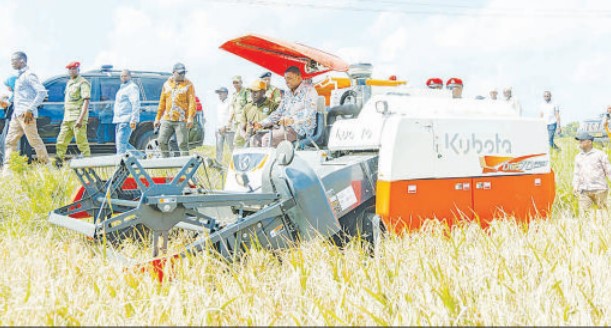
One issue that particularly concerned the Second Vice-President was Zanzibar’s continued dependence on imported rice despite having considerable agricultural potential. While inspecting rice farms and mechanised harvesting operations in Cheju, he called for increased investment to expand domestic rice production and improve food self-sufficiency.
He urged officials to strengthen support for farmers through modern farming equipment, extension services and practical training to enable them to operate agriculture as a profitable business.
Mr Hemed also stressed that higher production alone is not enough. Farmers need reliable markets, improved storage facilities, quality seed and better access to finance if they are to increase productivity and incomes sustainably.
ALSO READ: Police recover seven stolen motorcycles
His message reinforced the government’s commitment to transforming agriculture from subsistence farming into competitive agribusiness driven by productivity, efficiency and innovation. That commitment is already being demonstrated through strategic investments such as the construction of a modern Seed Farm at Kibonde Mzungu.
The facility is expected to improve the availability of quality rice seed, enabling farmers to achieve higher yields and greater productivity. The Minister for Agriculture, Irrigation, Natural Resources and Livestock, Suleiman Massoud Makame, said the sector is already recording encouraging results.
“Increased donor support and adoption of modern farming techniques have doubled rice yields, from 10 to over 22 bags per quarter acre,” he said. The achievement illustrates the impact of improved farming technologies, quality inputs and technical support in increasing agricultural productivity and strengthening food production. Throughout the inspection tour, one message remained consistent: leadership must be visible, accessible and responsive.
Rather than relying solely on reports, the Second Vice-President chose to engage directly with citizens, observe projects firsthand and hear people’s concerns from the communities where development is taking place. Such engagement strengthens accountability while enabling leaders to make informed decisions based on realities on the ground.
For communities such as Mtule, Bambi and Cheju, the visits represented more than routine inspections. They provided an opportunity to engage directly with national leaders, highlight local challenges and witness government commitment to finding practical solutions.
For farmers like Kombo Mohamed Khamis, the visits also reaffirm that agriculture is increasingly recognised as a strategic pillar of Zanzibar’s economy. His success demonstrates how investment, innovation and supportive government policies can generate employment, improve livelihoods and encourage more young people to enter the sector.
As the tour concluded, one message stood out clearly. Zanzibar’s development is not solely about constructing roads, ports or airports. While these investments remain essential, their ultimate purpose is to improve people’s lives by creating opportunities, strengthening livelihoods and expanding access to quality services. Equally important is a style of leadership that reaches communities, listens to citizens and works alongside them in shaping development.
For Zanzibar, this approach signals a shift from policies formulated in offices to solutions informed by the experiences of ordinary people. As infrastructure projects advance, farmers embrace modern technologies and leaders maintain close engagement with communities, the foundations are being laid for a more inclusive and prosperous economy.
The guiding principle echoed throughout the tour summed up that vision: agriculture remains the backbone of Zanzibar’s economy, and embracing scientific, commercial farming is essential for increasing productivity, creating employment and securing a more prosperous future for all.