Tanzania’s schools safer than before, but more needs to be done

DAR ES SALAAM: For years, Tanzania has invested heavily in expanding access to education, building classrooms, recruiting teachers and increasing school enrolment.
Yet education experts argue that the true measure of a successful education system is not only how many children sit in classrooms, but whether they feel safe enough to learn, speak, participate and fulfil their potential.
That reality has emerged as one of the strongest messages from the latest safe to learn national diagnostic exercise, which shows that although Tanzania has made significant progress in reducing violence against children, many schools continue to struggle with translating national child protection policies into everyday practice.
The assessment suggests that while the country’s legal and institutional framework has become stronger, implementation at district and school levels remains uneven, leaving many children exposed to violence, weak reporting systems and inadequate psychosocial support.
ALSO READ: Benchmark indices slip as rally pauses
The findings come at a time when Tanzania is receiving international recognition for reducing violence against children.
According to the 2024 Violence Against Children Survey (VACS), released by the government in 2025, all major forms of violence against children have declined compared to the baseline survey conducted in 2009.
The encouraging trend provided the foundation for the safe to learn assessment, which sought to understand what has contributed to the progress and where critical gaps still exist. Conducted by HakiElimu between September and October 2025 under the global safe to learn initiative, the assessment examined how effectively Tanzania’s education system prevents and responds to violence in and around schools.
Researchers assessed five key areas, including policy and legislation, school prevention and response systems, social norms, financing and evidence generation, with the goal of establishing a national baseline for monitoring progress over the next five years.
The study covered six regions across Tanzania Mainland and Zanzibar, involving ten districts and 348 participants drawn from government ministries, education officials, police gender desks, social welfare officers, teachers, head teachers, development partners, civil society organizations and students.
Researchers found that both Tanzania Mainland and Zanzibar have established comprehensive legal frameworks aimed at protecting children.
The country has ratified key international child rights conventions and incorporated violence prevention into national policies such as the National Plan of Action to End Violence Against Women and Children, the Law of the Child Act and the revised Education and Training Policy. These measures demonstrate strong political commitment to safeguarding children’s rights.
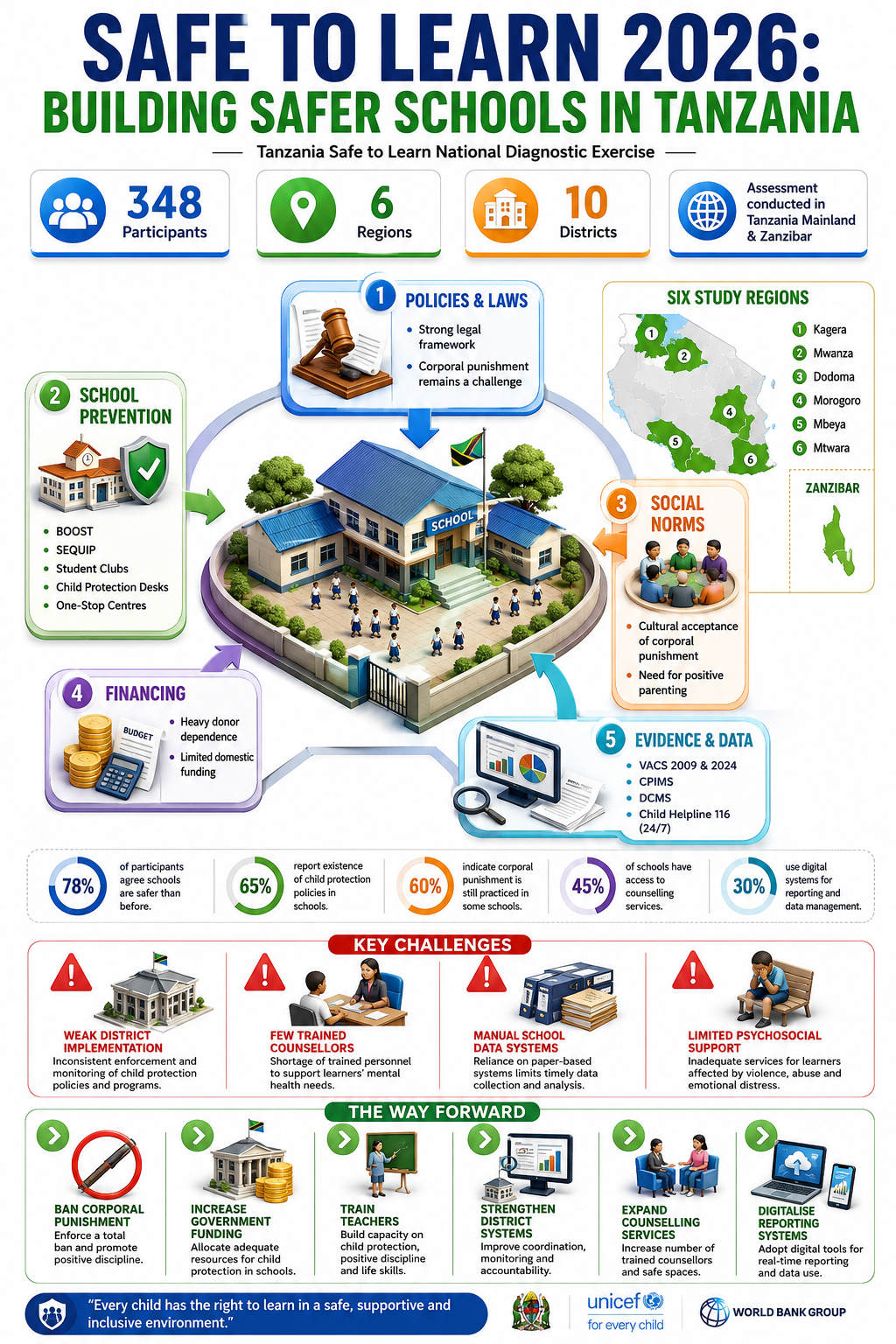
However, despite this impressive legal architecture, many schools continue to experience challenges because implementation weakens significantly below the national level. Researchers argue that this weakens national efforts to eliminate violence and conflicts with international child rights standards that advocate for positive discipline rather than physical punishment.
Zanzibar, meanwhile, has made greater progress towards discouraging corporal punishment, although cultural acceptance still presents challenges. The assessment suggests that this contradiction sends mixed messages to teachers, parents and communities.
On one hand, schools are expected to protect children from violence; on the other, some forms of physical punishment continue to be recognized within the disciplinary framework. Despite these concerns, the report highlights several encouraging developments that demonstrate Tanzania’s growing commitment to safer learning environments.
Government-supported education programmes such as BOOST for primary schools and SEQUIP for secondary education have incorporated school safety and violence prevention into their broader education reforms.
Speaking during the presentations of the finding’s which took place in Dodoma recently the University Dar es Salaam senior lecture Dr Hezron Onditi said that, Schools are also establishing child protection desks, student clubs, confidential reporting mechanisms and guidance services aimed at helping learners report abuse and receive support.
He highlighted that, in many communities, One-Stop centres now provide medical, legal and psychosocial services to survivors of violence, bringing different services together under one roof.
ALSO READ: Cloves, tourism lift Zanzibar exports 23pc
“Researchers note that these initiatives represent an important shift away from reacting after violence occurs towards creating school environments where abuse can be prevented, detected early and addressed more effectively,” he said.
He mentioned, “Yet the report warns that many of these achievements remain fragile because they depend heavily on donor-funded programmes rather than permanent government financing. Schools, particularly in rural areas, often lack trained counsellors and mental health professionals, while district authorities struggle with limited resources and insufficient capacity to supervise child protection systems effectively,”
“The report identifies one of the country’s biggest contradictions: while Tanzania promotes child protection through numerous laws and policies, corporal punishment remains legally permitted in Mainland schools under Education Circular No. 24 of 2002,” he indicated.
He said, one of the report’s greatest contributions is that it offers the first comprehensive national baseline for measuring progress in preventing violence in and around schools.
“By assessing five key pillars policy and legislation, school-based prevention and response, social norms, financing, and evidence generation the report provides government institutions, development partners and education,” He pointed out.
Dr Onditi indicated that, “Stakeholders with a clear understanding of where Tanzania is performing well and where additional investment is needed. This evidence-based approach makes future interventions more targeted and effective rather than relying on assumptions,”
To her part the lecture of UDOM University Dr Christina Jerome said during the lodge that, the report also highlights the importance of translating national policies into practical action. “While Tanzania has established strong legal and institutional frameworks to protect children, the assessment shows that implementation is often weaker at district and school levels,” she indicated.
She underscored that, “This finding is particularly important because it shifts the national conversation from creating more policies to ensuring that existing laws are effectively implemented. It reminds decision-makers that real change occurs when teachers, school leaders, district authorities and communities work together to put child protection measures into practice,”
He addressed that, “Another major benefit of the report is its emphasis on strengthening school environments as places where children can learn without fear of violence or abuse. Research has consistently shown that children who feel safe at school are more likely to attend classes regularly, participate actively in learning and achieve better academic outcomes,”
“By identifying gaps in counselling services, reporting mechanisms and psychosocial support, the report provides practical recommendations for creating schools that support both academic excellence and children's emotional well-being,” she indicated.
She advocated that, “Equally important, the assessment recognizes that preventing violence cannot be achieved by schools alone. It demonstrates the need for stronger collaboration among government ministries, local authorities, law enforcement agencies, health professionals, parents, religious leaders, civil society organizations and development partners.
Such a multi-sectoral approach strengthens referral systems for child protection cases while encouraging communities to take collective responsibility for children’s safety,” The Safe to Learn National Diagnostic Exercise concludes that while Tanzania has laid a strong policy and legal foundation for protecting children, greater efforts are needed to ensure these commitments translate into meaningful action at district and school levels.
Researchers maintain that sustained government investment, stronger coordination among stakeholders and community participation will be essential to building learning environments where every child is protected from violence and given an equal opportunity to learn and thrive.
The findings provide policymakers with a roadmap for strengthening child protection systems and advancing safe, inclusive and quality education across the country.