Investors seek growth as Tanzania opens new opportunities

DAR ES SALAAM: GLOBAL and local investors searching for opportunities in African markets are increasingly turning their attention to Tanzania, a country many now view as one of the continent’s most promising destinations for impact investment.
With strong economic fundamentals, expanding digital systems and a rapidly growing entrepreneurial ecosystem, Tanzania is positioning itself as a market capable of attracting long-term capital while supporting inclusive growth.
Small and medium enterprises (SMEs), which form the backbone of Tanzania’s economy, employ an estimated 5.7 million people and contribute approximately 27 per cent of the country’s Gross Domestic Product (GDP).
Across sectors such as agriculture, healthcare, renewable energy, and technology, entrepreneurs continue developing scalable solutions aimed at addressing both local and regional challenges. Recent economic indicators further strengthen the country’s investment case.
Tanzania recorded GDP growth of 6.4 per cent in the third quarter of 2025, while the national financial inclusion index increased from 0.69 to 0.81 within a single year.
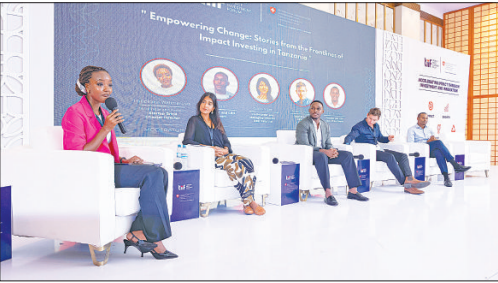
impact investing across Tanzania’s enterprise landscape
At the same time, rising digital penetration is creating new distribution channels, improving access to financial services, and strengthening market systems. Despite this progress, a major challenge persists. Many high-impact businesses and transformative ideas still struggle to access financing.
Although investor appetite continues to grow, numerous SMEs remain poorly positioned, underprepared, or largely invisible to the capital they urgently need to scale. It is within this context that the Tanzania Impact Investment Forum (TIIF) has emerged as a strategic platform designed to bridge the gap between capital and opportunity.
Founded under the stewardship of the Embassy of Switzerland in Tanzania, TIIF builds on more than a decade of ecosystem-building efforts aimed at strengthening impact finance and enterprise development in the country.
Launched in 2025, the forum was established on a simple but powerful premise: meaningful scale can only be achieved through alignment among investors, enterprises, development institutions, and government actors.
This means bringing together investment-ready businesses capable of meeting fiduciary standards, investors who understand local market realities, development finance institutions willing to use blended financing instruments, and government institutions that see themselves not merely as regulators, but as facilitators of investable growth.
TIIF exists to create this structured engagement and accelerate pathways toward scalable investment opportunities. The 2026 edition of the forum, themed “Unlocking Growth Capital: Investing in High Impact SMEs and Transformational Projects,” aims to deepen this commitment through four interconnected pillars designed to address key barriers within Tanzania’s investment ecosystem.
The first pillar focuses on financing high-impact SMEs to support inclusive economic growth. Organisers believe strengthening the investment pipeline for SMEs is essential to achieving national development ambitions.
Across sub-Saharan Africa, SMEs account for approximately 95 per cent of all registered businesses. However, only around 20 per cent are able to access formal financing. One of the major obstacles has been the gap between enterprise maturity and investor-readiness infrastructure.
Many businesses possess strong ideas and market potential but lack the systems, reporting structures, documentation, and measurable impact frameworks required by institutional investors.
TIIF 2026 intends to address this challenge through investment preparation programmes, standardised impact measurement systems, and curated matchmaking initiatives connecting investors with vetted enterprises.
For investors, this approach creates access to structured and credible investment pipelines. For SMEs, it offers an opportunity to build the credibility and visibility needed to attract institutional financing.
The second pillar centres on blended finance for transformational projects, recognising that large-scale investments often require catalytic instruments capable of reducing risk and attracting private capital. Globally, every dollar of concessional financing deployed through blended finance structures mobilises an average of 4.10 US dollars in commercial investment.
In sub-Saharan Africa, however, the ratio remains significantly lower at approximately 1.80 dollars for every concessional dollar invested.
This gap reflects both the scale of unmet financing needs and the enormous opportunity for properly structured blended finance mechanisms to drive transformative impact. Notably, Africa already accounts for nearly 40 per cent of all blended finance transactions worldwide, signalling increasing investor confidence in the continent’s long-term growth prospects.
As part of this effort, TIIF 2026 will implement an Investment Readiness and Deal Room Programme in partnership with Venture Capital for Africa (VC4A). The initiative will help prepare and profile Tanzanian growth-stage enterprises to meet the fiduciary and documentation standards required in blended finance transactions.
Selected businesses will then be presented directly to curated investor panels. In addition, participating ventures will receive exposure through the TIIF Deal Book and gain access to VC4A’s global network of more than 1,400 investment funds and angel investor networks.
The programme is designed to connect capital with opportunity in a more deliberate, organised, and structured manner.
The third pillar focuses on climate-smart growth and green industrialisation, positioning Tanzania’s climate context as a strategic economic advantage rather than simply an environmental challenge. Globally, climate and energy investments already account for nearly 29 per cent of the private asset impact fund market.
Investors are increasingly integrating climate risks into their portfolios, recognising that longterm returns are now closely tied to resilience and sustainability. The World Bank’s 2024 Country Climate and Development Report for Tanzania identifies the private sector as a key player in addressing climate financing gaps while supporting long-term economic growth.
ALSO READ: TZ courts global investors with 8tri/- project
Tanzania’s renewable energy potential, combined with the government’s updated Nationally Determined Contributions and Climate Change Response Strategy, has strengthened the country’s credibility as a destination for climate-focused investment.
For investors seeking sustainable opportunities with long-term upside, Tanzania presents an increasingly attractive entry point. The fourth pillar highlights digital and market systems as critical enablers of investment scale. Strong payment infrastructure reduces transaction costs, improves data quality, enhances transparency, and builds the trust necessary for investor confidence.
Tanzania has already made significant progress in this area. In 2024, the Tanzania Instant Payment System (TIPS) processed real-time transactions worth 29.9tri/-, equivalent to approximately 11.6 billion US dollars, more than doubling the previous year’s value.
Meanwhile, active mobile money accounts reached 60.75 million, representing a 17.5 per cent increase yearon-year. Tanzania also became the first African country to implement full mobile money interoperability, further strengthening financial inclusion and digital accessibility.
According to a Visa study, 84 per cent of Tanzanian SMEs adopted digital payment systems within the past two years. The study further estimates that wider adoption of digital payments could contribute up to two per cent to national GDP growth.
For investors, the expansion of digital systems generates investment-grade data, strengthens market transparency, and increases the efficiency and reach of interventions across sectors.
Ultimately, TIIF 2026 seeks to create stronger relationships between local, regional, and global capital through deliberate collaboration among ecosystem actors. The broader vision is to move Tanzanian enterprises beyond early-stage promise and toward investment-ready scale capable of driving longterm economic transformation.