‘Reforms key to Vision 2050’
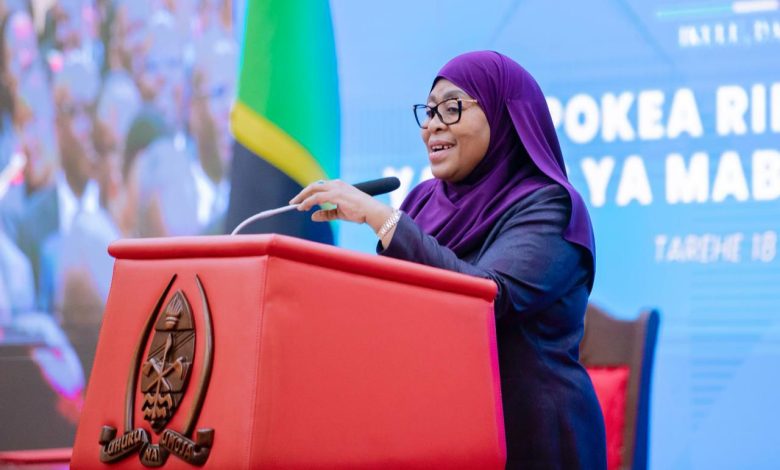
DAR ES SALAAM: PRESIDENT Samia Suluhu Hassan yesterday said comprehensive tax reforms are crucial in driving the nation’s ambition to build a 1 trillion US dollar economy under Vision 2050.
She said this at the State House in Dar es Salaam after receiving a detailed report from the Presidential Commission tasked with evaluating the country’s tax system.
She said the report comes at a defining moment as the government seeks to create a sustainable financial base that can support such a massive economic leap.
“The 1 trillion US dollar goal is a central pillar of Vision 2050, which requires a radical shift in how the country collects and manages its revenue,” Dr Samia said.
She said the commission was formed specifically to conduct a thorough assessment of the tax system following longstanding complaints from citizens, businesspeople, investors and development stakeholders.
The Head of State further said that these stakeholders have often pointed to challenges within the existing system that hinder the very growth the national vision seeks to achieve.
She said that this assessment is the first of its kind in over three decades, coming 35 years after the Mtei Commission of 1989.
“While previous systems served the country in the past, change is a natural part of development and systems must be reviewed to reflect current economic realities. The work of this commission is intended to modernise the tax environment to ensure it aligns with the investment and business needs required to make the 1 trillion US dollar economy a reality,” she said.
President Samia said the implementation of Vision 2050 will rely heavily on the cooperation of various sectors whereby 22 per cent of the vision’s implementation will be undertaken by the government, 70 per cent by the private sector and other stakeholders and 8 per cent by public institutions.
“Therefore, reforms in tax policies, tax laws and tax administration are essential,” she said.
She said the government recognises that without a conducive tax environment, the private sector cannot fulfil its 70 per cent mandate.
Dr Samia said the report arrived while the world is undergoing major technological, economic and political changes where there is increasing technological competition and trade conflicts among major nations which affect global trade strategies.
The Head of State said the government will use the 4Rs philosophy—Reconciliation, Resilience, Reforms and Rebuilding, as the specific foundation for implementing the 284 recommendations.
ALSO READ: Dr Samia orders tax system reforms to be implemented in the short, medium, and long terms
She said that reforms often come with challenges and some areas may slow down during the transition, but the 4Rs will ensure the nation remains united during the process.
“I urge all stakeholders, including the government, business community, entrepreneurs and civil society, to embrace change and work together to rebuild the country using the 4Rs approach, the benefits will be realised in the future,” she said.
She said the 4Rs will guide the government in ensuring that the transition to a new system is inclusive and does not leave any group behind.
The President said she had reviewed the recommendations which focus on improving tax policies, laws, the investment environment and ICT systems.
According to her, if well implemented, these recommendations will lead to a fair and equitable tax system, currently there are many complaints among businesspeople, where some pay appropriate taxes while others pay less.
“The recommendations aim to ensure fairness in taxation based on business scale, as well as stability in tax payments, with clear and consistent policies and a unified legal interpretation,” she said.
She said tax policies should be neutral, not oppressive or biased and should not burden those engaged in economic activities with the goal to create a predictable environment where investors feel safe.
The President said the government will consider the recommendation to change the name Tanzania Revenue Authority (TRA) to Tanzania Revenue Services.
She said while the Tanzania Revenue Authority has made efforts to strengthen collection over the past four years, national needs remain high.
“The use of domestic resources to build the national economy is a key pillar at this time, which is why there is a strong emphasis on increasing revenue collection to enable the country to finance its own development,” she said.
Dr Samia said the chairperson of the commission informed her that implementing these recommendations could increase revenue collection to 18 per cent of the Gross Domestic Product (GDP).
She said this would enable the country to fund domestic expenditures independently and reduce reliance on external aid for essential services like water, education, electricity and road maintenance.
President Samia said the government will prioritise the formalisation of businesses to widen the tax base.
“A large number of citizens currently operate in the informal sector, which limits their access to loans and capital growth. “Formalisation of businesses and economic activities will be prioritised to build an inclusive economy,” she said.
She said the implementation of the 284 recommendations will be carried out in short, medium and long-term phases.
“This process will include legal reforms and the installation of new systems, including Artificial Intelligence technologies. The long-term phase is intended to be completed within the current administration to lay a strong foundation for Vision 2050,” Dr Samia said.