Parliamentary team hails new UDSM AI centre

DAR ES SALAAM: THE Parliamentary Standing Committee on Education, Culture and Sports has expressed satisfaction with the completion of a new Artificial Intelligence (AI) building at the College of Information and Communication Technologies (CoICT) of the University of Dar es Salaam (UDSM), describing the project as a major step toward strengthening Tanzania’s capacity in emerging technologies.
The committee, led by its Chairperson Husna Sekiboko, visited the facility yesterday to inspect the project and confirmed that construction of the building has been completed.
Key equipment for the facility has already arrived and is awaiting installation before teaching activities begin.
Speaking during the visit, Ms Sekiboko said the committee was impressed by the progress of the project and the institution’s level of preparedness.
“Today we have come to witness something very important. What we see clearly is that President Samia Suluhu Hassan continues to implement the ruling party’s manifesto through major development initiatives in various institutions across the country,” she said.
She noted that the education sector, under the Ministry of Education, Science and Technology, has undergone significant transformation under the leadership of the Minister, Professor Adolf Mkenda.
“I would be unfair if I did not sincerely thank and congratulate the leadership of the ministry led by Prof Mkenda for the remarkable work they are doing,” she said.
Ms Sekiboko said the projects being implemented by universities across the country demonstrate prudent use of public funds and have the potential to contribute significantly to national economic growth.
“The projects we have visited clearly show that public resources are being used effectively and can generate substantial benefits for the country’s economy,” she said.
She also highlighted the importance of cooperation among the three pillars of the state, the Executive, the Legislature and the Judiciary in strengthening Tanzania’s preparedness for technological transformation.
According to Ms Sekiboko, the Speaker of the National Assembly, Mr Mussa Azzan Zungu, recently convened a meeting involving Prof Mkenda and officials from the ministry to discuss strategies for mobilising resources to strengthen artificial intelligence training in universities.
She said the meeting provided guidance on securing funds to enhance the capacity of lecturers and students while improving learning infrastructure to support the effective and responsible teaching of AI.
ALSO READ: BoT signs strategic deal on AI, data innovation
Ms Sekiboko noted that artificial intelligence represents one of the most significant technological revolutions of the modern era and Tanzania must prepare to harness its opportunities while addressing potential challenges.
“The technological revolution in computing is enormous and will continue for many years. Some jobs currently performed by humans may eventually be replaced by computers,” she said.
She added that it is, therefore, essential for the government to incorporate AI development into national planning and budgeting processes.
“As Parliament prepares to discuss and approve the budget of the Ministry of Education, Science and Technology, we will ensure there is a specific allocation for the development of AI training for universities, students, and teaching infrastructure,” she said.
She stressed that the goal is to ensure artificial intelligence becomes an opportunity for development rather than a threat to the country.
Speaking at the meeting, Prof Mkenda said the government has already taken steps to strengthen international cooperation in artificial intelligence and data science.
As part of these efforts, Tanzanian students have been sent abroad to pursue studies in the fields.
“Currently, 16 Tanzanian students are studying in Johannesburg, while another 34 are pursuing similar programmes in Ireland,” Prof Mkenda said.
He added that the government is also planning to establish a national data centre aimed at strengthening the protection and security of citizens’ information while supporting the growth of digital services and innovation.
The University of Dar es Salaam Vice-Chancellor, Professor William Anangisye, said the new AI facility will position the university as a leading centre for advanced technology training and research in the region.
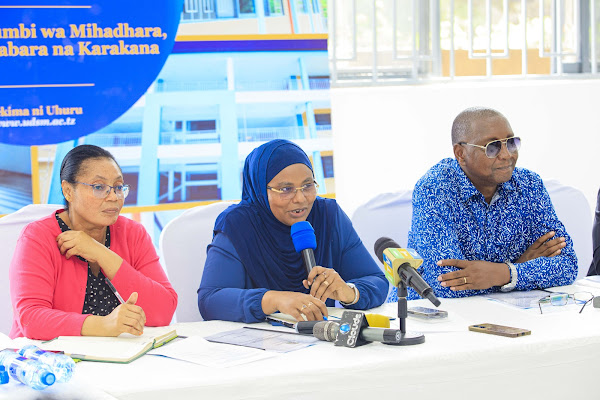
He said the building will support cutting-edge research in artificial intelligence, data science and digital innovation, while strengthening partnerships between the university, industry and international research institutions.
Meanwhile, the Chairperson of the University of Dar es Salaam Council, Ambassador Mwanaidi Maajar, said the investment demonstrates the government’s strong commitment to building a knowledge-based economy and preparing young Tanzanians for the digital era.
Experts believe that expanding artificial intelligence education and infrastructure will help Tanzania improve productivity, strengthen innovation, enhance public service delivery and create new opportunities in sectors such as agriculture, health, finance and transport.