Mwinyi’s first 100 days boost Zanzibar’s blue economy
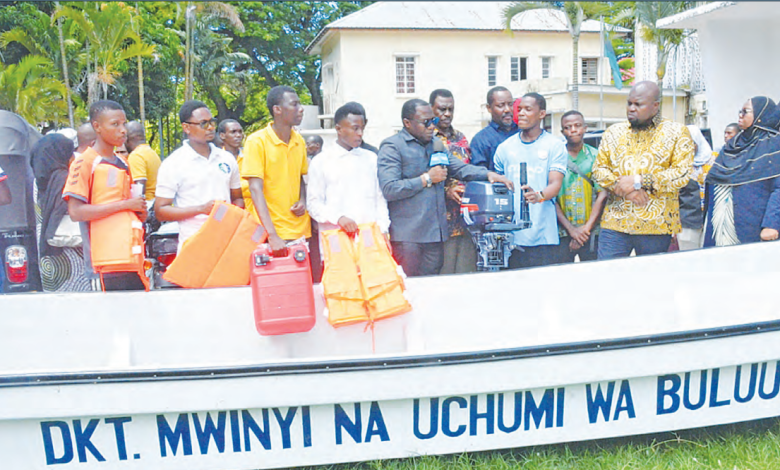
ZANZIBAR: ZANZIBAR has accelerated efforts to expand its blue economy through new fishing infrastructure, seaweed processing initiatives, and oil and gas exploration, marking key achievements during the first 100 days of President Hussein Mwinyi’s second term.
The progress was highlighted by the Minister for Blue Economy and Fisheries, Mr Masoud Ali Mohamed, during a press briefing on Monday, outlining the ministry’s implementation of development programmes in the early months of the government’s eighth phase.
The minister said the ministry’s work focused on three key areas: fisheries and marine farming, oil and gas development, and coordination of broader blue economy activities.
He noted that the fisheries sector, including artisanal, mid-scale, deep-sea fishing, aquaculture and marine conservation, remains vital in supporting livelihoods and the economy.
“Government support for entrepreneurs, including provision of fishing boats, equipment and seaweed farming tools, has significantly increased harvests of fish, seaweed and other marine products,” the minister said.
To ensure sustainable growth, the government is investing in fishing infrastructure across Zanzibar.
Preparations are underway for a new fishing port at Ngalawa, currently in the design stage, which will serve local and international deep-sea vessels. Meanwhile, a modern fish landing site in Mkoani, Pemba, is complete, serving around 10,000 residents and handling up to 250 small fishing vessels daily.
Construction of a landing site in Fungurefu is 80 per cent complete, and work has begun on six additional sites in Kengenja, Kiwani, Msuka, Fukuchani, Unguja Ukuu and Matemwe Kigomani.
Through the Zanzibar Fishing Company (ZAFICO), a facility for anchovy entrepreneurs is being completed in Ndagoni Village, Pemba. Plans are also underway to acquire a 25-metre deep-sea fishing vessel and four 18-metre boats to boost fish production.
Skills development is a priority. A fisheries training institute will be constructed in Fungurefu to provide courses up to diploma level, equipping youth with technical expertise in the blue economy.
For sustainable management, the ministry has proposed repealing the Fisheries Act No. 7 of 2010 and replacing it with a new Fisheries Development Act, which will lead to the establishment of the Zanzibar Fisheries and Marine Conservation Authority. Marine farming initiatives are expanding.
A total of 36,322 sea cucumber fingerlings have been distributed to 17 groups in Unguja and Pemba, creating about 85 jobs for women and youth. Seaweed farming is also receiving renewed investment.
Through the Zanzibar Seaweed Company (ZASCO), the government has purchased two seaweed processing machines from India and the UK for the Chamanangwe plant to produce bio-stimulant fertilisers, dry fertiliser, and animal feed.
The equipment is expected in April 2026. ZASCO is also partnering with MDAXH Company to establish a seaweed processing factory in Fumba for food supplements, with machinery procurement already underway.
ALSO READ: Tanzania, UNTBLDC agree to enhance ties in implementing blue economy, agribusiness
Additional support comes from the IFAD-funded agriculture and fisheries program, which has purchased five processing machines for distribution in Unguja and Pemba.
Research is being strengthened through the Zanzibar Fisheries and Marine Resources Research Institute (ZAFIRI), which has set up a laboratory for improving seaweed seedlings using tissue culture.
Seed nurseries in northern Unguja have already yielded 1,376 kilogrammes of seaweed seedlings, distributed to 63 farmers across four groups. Beyond fisheries, the government is advancing oil and gas exploration.
Through the Zanzibar Petroleum Development Company (ZPDC), the ministry signed an agreement with Africa Geophysical Services (AGS) of Oman to conduct 3D seismic surveys on Block Z2 onshore, identifying potential drilling locations.
The ministry also continues to coordinate sustainable ocean resource use under Zanzibar’s Marine Spatial Planning (MSP) initiative.
So far, 13 stakeholder meetings have been held, and joint patrols with Community Management Groups have conducted 128 operations to combat illegal fishing.
Looking to 2030, plans include expanding deep-sea fishing, developing fish processing industries, reviving the Malindi fish processing plant and establishing a Blue Economy Special Investment Zone in Fungurefu, North Unguja.
Other priorities include expanding seaweed valueaddition industries, supporting farmers with capital and equipment, and continuing oil and gas exploration.
Minister Mohamed said the achievements during the first 100 days reflect the government’s commitment to transforming Zanzibar into a regional hub for the blue economy while creating jobs and improving livelihoods for coastal communities.