Olduvai Gorge: Walking in the footsteps of our ancestors
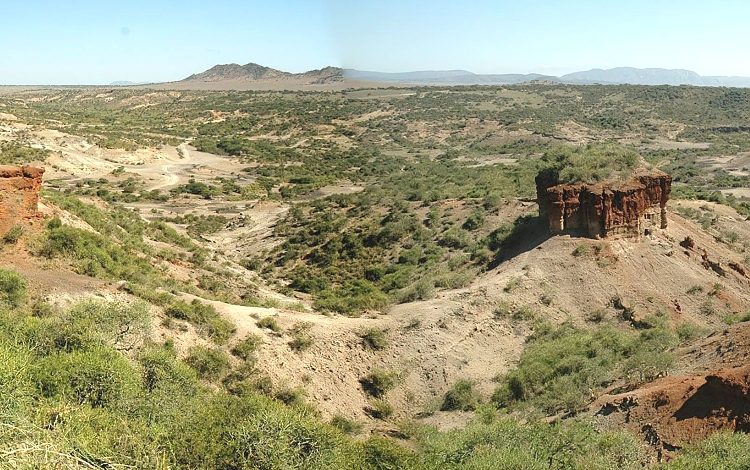
ARUSHA: THE wind sweeps across jagged cliffs and deep ravines at Olduvai Gorge, carrying whispers of footsteps that walked the Earth millions of years ago.
Here in northern Tanzania, within the Ngorongoro Conservation Area in Arusha Region, the story of humanity is etched into rocks, fossils and soil.
Every discovery, from ancient stone tools to fossilised skulls, tells the story of ancestors who walked upright, crafted the first tools and adapted to a changing world long before cities, books or governments existed.
During a visit to the historic site, the ‘Daily News’ witnessed how the landscape itself appears to preserve the memory of humanity’s earliest journey.
“Olduvai is like a giant history book written in stone,” said Jumanne Maburi, Principal Conservator of Antiquities II at Olduvai Gorge.
“Each layer of earth, each fossil and each footprint connects us directly to our past. When you stand here, you can almost feel the presence of early humans walking across this land millions of years ago.”
Stretching nearly 50 kilometres through the eastern Serengeti plains, Olduvai Gorge is often called the ‘Cradle of Mankind.’
The steep walls of the gorge expose layers of earth that record millions of years of life and environmental change. For scientists, these layers are more than geological formations.
They are pages in a story about how humanity evolved, adapted and survived.
From the earliest bipedal hominins about six million years ago to the emergence of Homo sapiens roughly 200,000 years ago, Olduvai Gorge offers one of the most detailed records of human evolution anywhere on Earth.
Visitors who stand at the edge of the gorge today look out over a landscape that appears timeless. Yet beneath the dusty ground lie traces of the earliest chapters of human history.
According to Maburi, the story of humanity begins during the Pliocene Period, roughly six million years ago, when some of the earliest representatives of human evolution appeared in Africa.
Among them were Sahelanthropus tchadensis in Chad, Ardipithecus kadabba in Ethiopia and Orrorin tugenensis in Kenya.
These early species were partially bipedal. They could walk upright for short distances but still relied heavily on trees for safety and food. Around 4.2 million years ago, the genus Australopithecus began to diversify across Africa.
Species such as Australopithecus anamensis, Australopithecus afarensis, Australopithecus africanus and Australopithecus boisei evolved to survive in different environments.
By about 3.5 million years ago, several species of early hominins lived side by side across the African landscape. One of the most famous discoveries connected to this period was the partial skeleton of Australopithecus afarensis, discovered in Ethiopia in 1974 and nicknamed Lucy.
Lucy became a global symbol of early human evolution because her bones revealed that upright walking developed long before large brains.
Not far from Olduvai Gorge, another discovery provided dramatic proof of this early bipedalism. At Laetoli in Ngorongoro District, scientists uncovered fossilised footprints preserved in volcanic ash.
The footprints, estimated to be about 3.6 million years old, clearly show early human ancestors walking upright across a prehistoric landscape.
“These footprints are a direct connection to our ancestors,” Maburi explained.
“When you walk at Laetoli, you feel the continuity of life stretching across millions of years.” Scientific exploration at Olduvai Gorge began more than a century ago.
In 1911, German scientist Wilhelm Kattwinkel discovered the gorge while studying tsetse flies. His findings attracted the attention of geologist Hans Reck, who organised the first major expedition in 1913.
During this expedition, more than 1,700 fossils were collected and the geological layers of the gorge were mapped for the first time.
However, it was the work of Louis Leakey and Mary Leakey in the 20th century that transformed Olduvai Gorge into one of the world’s most famous archaeological sites.
Beginning in the 1930s, the Leakeys carried out extensive excavations that uncovered stone tools, fossilised bones and evidence of early human activity.
By 1934, researchers had identified the earliest known stone-tool culture, later named the Oldowan industry.
These tools, made by striking one stone against another to produce sharp cutting edges, represent the earliest known technology created by humans.
ALSO READ: Marking the 67 years of the discovery of the skull of Early Man at Olduvai Gorge
“Some of the most important discoveries at Olduvai include early stone tools, fossil skulls of Homo habilis and Paranthropus boisei, and thousands of animal bones showing how early humans processed meat,” Maburi said.
“These discoveries help scientists understand how our ancestors lived, hunted and adapted to their environment.”
Among the most famous fossils found in the gorge is OH5, a skull of Paranthropus boisei discovered in 1959.
Because of its enormous molars and powerful jaw muscles, the fossil became popularly known as “Nutcracker Man.”
Another important discovery was the Peninj Mandible, a fossil jawbone with large molars adapted for chewing tough plant foods.
“Many of the fossils discovered here are between about 1.9 million and more than two million years old,” Maburi explained.
“The stone tools and animal bones associated with them show how early humans were beginning to develop technology and new survival strategies.”
Around two million years ago, fossils of Homo habilis began appearing in the archaeological record at Olduvai.
Nicknamed ‘handy man,’ Homo habilis is believed to have been one of the earliest makers of stone tools. Fossils such as OH24, sometimes called ‘Twiggy,’ and OH62 reveal individuals with slightly larger brains and smaller teeth than earlier hominins.
These physical changes suggest that early humans were beginning to develop more advanced cognitive abilities.
Later, around 1.5 million years ago, another species emerged: Homo erectus. This species looked more similar to modern humans, with longer legs, larger bodies and brains that averaged between 800 and 900 cubic centimetres.
Homo erectus is also associated with Acheulean hand-axes, more sophisticated stone tools that required greater skill to produce.
“Olduvai Gorge is central to human evolution studies because it preserves a long and continuous sequence of geological layers,” Maburi explained.
“These layers allow scientists to trace how human ancestors changed over millions of years and how they adapted to climate changes and new environments.”
Life for early humans in this region was far from easy. Two million years ago, the landscape around Olduvai was a mixture of open savanna, woodland and lakes. Predators such as lions, hyenas and sabre-toothed cats roamed the plains.
Early humans had to rely on cooperation, tool use and careful observation to survive. Evidence from sites such as FLK Zinj shows more than 250 animal bones bearing cut marks made by stone tools.
These marks reveal that early humans butchered animals and extracted marrow from bones, a rich source of nutrients that may have helped fuel brain growth. Walking through Olduvai Gorge today, visitors can still see some of the excavation sites where these discoveries were made.
Scientists and conservationists have worked to transform the area into an educational destination that allows visitors to explore human history while protecting fragile archaeological remains.
“We communicate science to visitors through guided tours, museum exhibits and displays of fossil replicas,” Maburi said.
“Interpretive panels explain the discoveries in simple language so that people without scientific training can still understand their importance.”
The Olduvai Gorge Museum stands near the edge of the gorge, displaying replicas of famous fossils, ancient stone tools and educational materials explaining the process of human evolution.
“Facilities here include the museum, research centres, viewing platforms and guided tours for visitors,” Maburi explained.
“These facilities help tourists and students understand both the science and the history of the discoveries.”
For many visitors, standing in the landscape where humanity’s earliest ancestors once lived is an emotional experience.
Michael Thompson, a historian from the United States, gazes across the sweeping ravines and exposed layers of earth.
“I’ve studied human evolution in books for years, but standing here is completely different,” Thompson said. “You can see the layers of earth and imagine the generations of early humans who lived here.”
Beside him, Luca Bianchi, an Italian archaeologist visiting the site, kneels beside a fossil replica displayed at the museum. “The stratigraphy here is extraordinary,” Bianchi said.
“Every layer of soil represents a chapter in human history. When you study the tools and fossils together, you begin to understand how long and complex our evolutionary journey really was.”
ALSO READ: Ngorongoro-Lengai Geopark: Where earth tells its stories
Nearby, Sarah Miller, a Canadian anthropology student, scans the distant cliffs where early humans once walked.
“I never imagined I would stand in the place where our ancestors lived and hunted,” Miller said. “Seeing this with my own eyes makes everything I’ve studied feel real.” Not far away, Aiko Tanaka from Japan pauses to photograph the vast landscape.
“Olduvai is more than a fossil site,” Tanaka said.
“It is a place where nature and history come together.” Beyond its scientific importance, Olduvai Gorge also carries profound meaning for Africa. “Africa is the birthplace of humanity,” Maburi said.
“Sites like Olduvai remind Africans that this history belongs to them and should inspire pride in our contribution to global knowledge.”
He believes the site has enormous potential to promote educational tourism across the continent.
“Olduvai can inspire educational tourism by bringing students, researchers and travellers to experience human history in the landscape where it happened,” Maburi said.
As the sun sets over the Serengeti plains and shadows stretch across the gorge, the wind moves gently along the ancient cliffs. Standing at the viewpoint, it becomes clear that humanity did not emerge suddenly.
“Human evolution was a long process of learning, adaptation and survival,” Maburi reflected.
Olduvai Gorge is more than an archaeological site. It is a reminder that the story of becoming human took millions of years to unfold.
Every fossil, every stone tool and every footprint preserved in the ancient soil tells part of that story. And for those who walk the dusty paths of Olduvai today, the echoes of the past still seem to travel in the wind above the ancient cliffs.