Mwinyi unveils plan to fix classroom crisis
ZANZIBAR: PRESIDENT Hussein Ali Mwinyi has vowed that his government will focus on the construction of multi-storey schools as a long-term solution to classroom shortages and the double-shift system that has for years characterised education in many parts of Zanzibar.
For decades, pupils in the islands’ fast-growing neighbourhoods have attended classes in shifts some early in the morning, others late into the evening as overcrowded classrooms strained limited land and resources.
President Mwinyi said this reality must change permanently.
Speaking while inaugurating the new Muungano Primary School in the Kibanda-Maiti area of the Urban West Region, over the weekend, Dr Mwinyi said vertical school construction is the most viable response to Zanzibar’s demographic and spatial pressures.
“Zanzibar has limited land, but a rapidly growing population,” the President said.
“We must use the land we have wisely to ensure every child learns in a safe, modern and dignified environment.”
The inauguration of the three-storey school formed part of activities marking the 62nd anniversary of the Zanzibar Revolution, which President Mwinyi said symbolises the enduring promise of equal access to basic services, particularly education.
He said the government plans to raise the education sector budget to 1tri/-, making it the country’s top development priority.
As part of this strategy, Zanzibar in May this year signed a €79.962 million (about 240bn/-) loan agreement with Deutsche Bank, backed by Spain’s export credit agencies and facilitated through CRDB Bank.
The funds will support the construction of 29 modern schools across Unguja and Pemba.
“These schools will provide better learning environments and help us end congestion in classrooms,” the President said.
Preparations are already underway for new schools in Fuoni Kibondeni, Jumbi and Chunga in Unguja, as well as Kiuyu Minungwini, Mchanga Mdogo and Micheweni in Pemba, under a World Bankfunded project.
Looking ahead, Dr Mwinyi announced that in early 2026 the government will begin constructing additional multi-storey schools in Jang’ombe, Mikunguni, Kianga and Mtoni Kidatu in Unguja, and in Kengeja, Wesha and Miti Ulaya in Pemba.
“Using domestic funds, the government plans to construct 18 more vertical schools across Unguja and Pemba,” he said.
Since assuming office, the Eighth Phase Government has already built 35 multi-storey schools, significantly easing overcrowding.
However, challenges remain, particularly in the Urban West Region, which is home to nearly half of Zanzibar’s population.
ALSO READ: CCM pledges to solve Dar’s traffic crisis within five years
With an annual population growth rate of about 3.7 per cent, President Mwinyi stressed that strengthening education infrastructure is no longer optional.
“Every child in Zanzibar deserves access to quality education,” he said.
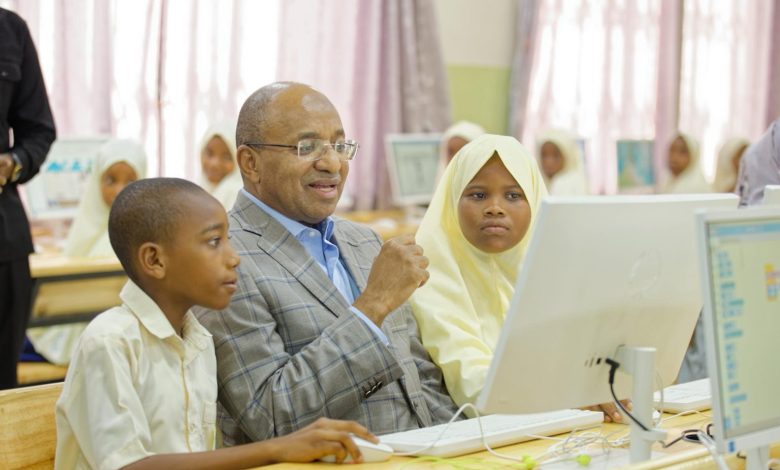
Beyond physical infrastructure, the President said the government is accelerating the integration of information and communication technology in education.
In the 2025/2026 financial year, plans are underway to connect 70 schools to the national fibre-optic network, distribute 2,000 desktop computers for laboratories, provide 4,000 laptops for students and establish 25 smart classrooms to enhance teaching and learning.
Recognising that expanded infrastructure must be matched with adequate staffing, Dr Mwinyi said the government recruited 1,741 teachers in 2024/2025 to meet rising demand.
“In the current financial year, 492 teachers have already been employed, with a target of recruiting 1,500 more, while continuing to improve teachers’ welfare,” he said.
Highlighting the significance of Muungano Primary School, the President said its name and purpose reflect the ideals of the 1964 Revolution, justice, equality and access to basic services.
“The foundations of the Revolution live on when every child, regardless of where they are born, has an equal chance to learn and succeed,” he said.
Providing technical details, the Permanent Secretary in the Ministry of Education and Vocational Training, Mr Khamis Abdalla Said, said the 6.1bn/- school was built by Fuchs Construction Limited.
The three-storey facility has 42 classrooms, laboratories, an ICT room, a library and 52 toilets, and can accommodate up to 1,890 pupils, with an average of 45 students per classroom.