

How the Netherlands poultry book will unlock poultry sector in TZ
IN Tanzania, poultry farming plays an important role in both urban and rural settings in terms of food security, source of income and in meeting other social obligations such as dowry and rituals.
On the other hand in the Netherlands (7,066 kilometers away by flight) you land in a country that is home to some of Europe’s most successful poultry meat and egg producers. Besides this, the Netherlands is 240 per cent self-sufficient in broiler meat and 300 per cent in eggs and in a nutshell, poultry and egg production are successful industries in the country.
Studying the Netherlands poultry industry, one would realise that the country’s Kuroilers chickens are dual-purpose breeds reared for both their meat and eggs.
They can feed on a diet of chicken and agricultural waste, and produce around 150 eggs per year, compared to the native Tanzania hens that can lay only 40 eggs per year.
Equally, Kuroiler chickens have unique genetic features that make them highly resistant to diseases, and breeding them is consistently changing the poultry industry in Africa – both at subsistence and commercial level.
Something to borrow here? Yes, last week the Netherlands through its embassy in Tanzania organised a seminar on Poultry Health in Dar es Salaam, where several participants including the Ministry of Livestock and Fisheries, local poultry keepers in their organisations namely Tanzania Feed Manufactures Association, Southern Agricultural Growth Corridor of Tanzania (SAGCOT) among others attended.
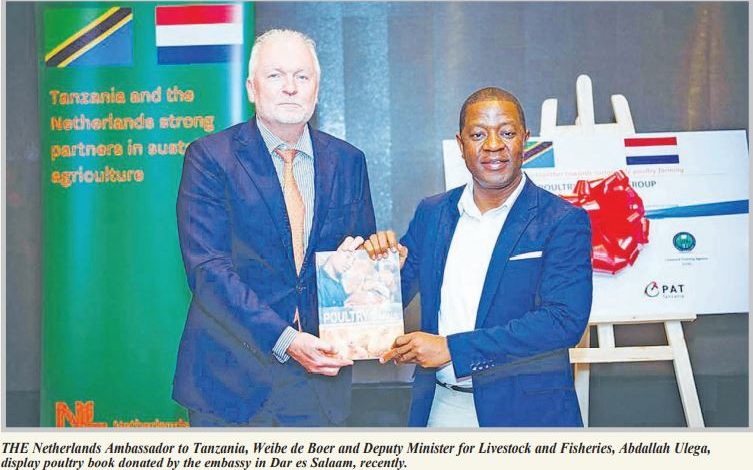
Gracing the occasion, the Deputy Minister for Livestock and Fisheries, Abdallah Ulega was briefed in another milestone by the ambassador launching a poultry book to Tanzanians for a professional poultry keeping guideline, especially for researchers, academicians, poultry keepers and training institutions imparting skills on poultry so that local farmers acquire firsthand information on sustainable poultry farm that is addressing poultry health for the keepers.
It was good that the seminar was also asked to deliberate on the need for setting standard Operation Procedures (SOPs) as a step towards addressing poultry health. In his speech, the ambassador noted that with the programme of ‘Kukua na Kuku’ that loosely translates as Growing with Chicken the initiave will transform Tanzania’s poultry sector using Dutch technologies, which have proved successful given the freshness and quality of the strengths in the poultry industry.
Visit Europe; don’t be surprised to be told that the Dutch poultry industry is the international leader. With entrepreneurship, quality and logistics, businesses have been able to maintain their strong position in eggs and poultry meat.
If you eat an egg or a piece of chicken in Northwestern Europe, chances are high that it’s from the Netherlands. The Netherlands is the world’s largest exporter of eggs for consumption and egg products, and the third largest exporter of chicken meat.
Of the 10 billion eggs that Dutch chickens lay annually, 6.5 billion go abroad and 50 per cent of the meat and the hatching eggs also end up being exported.
It was with this background of excellence that Tanzanians will have to change mindset and start serious poultry business using such a professional book instead of many running poultry as a hobby and investing a lot of money believing that, by simply doing so, they will almost automatically become rich.
With such a professional book, it should be borne in mind that poultry farming will be a very promising business if Tanzanian farmers will fully follow all the procedures for the business, including vaccinating the birds as and when due, as well as closely monitoring their progress all along the line.
With the ambassador being asked to lead translating the book into Kiswahili- a language spoken by many in Tanzania, poultry farmers will get skills on the steps poultry keeping take and know what to do to succeed in the venture.
None should be cheated, the market for chickens and chicken products is quite large in the country and globally, and the poultry business is very promising if chicken farmers would only go about the business functionally.
It was good the ambassador also clarified that the Kukua na Kuku impact cluster would enhance capacity building of local farmers throughout the value chain in order to improve their efficiency and quality of production and increase the demand for poultry products, adding: “In cooperation with local stakeholders the aim is to establish a thriving and competitive Tanzanian poultry sector that is based on a sound business model.
Tanzania and the Netherlands are important trade partners and maintain a valuable partnership towards a sustainable food sector. The poultry sector in the Netherlands is founded on family businesses and corporations who have been seeking long-term solutions for centuries.
Our farmers are entrepreneurs. Innovation and highly efficient production, in combination with working in partnerships with companies, knowledge institutes and government organizations, has made the Netherlands a global leader in the poultry sector.
With this knowledge and experience, the Dutch sector can help to further develop the sector in Tanzania.
That is why the ambassador and Mr Ulega delivered the same message to farmers that poultry farming provides high yields, requires not much capital to start, does not require lots of space and above all their eggs and meat are a rich source of protein and other kinds of vitamins and minerals to a family.
This has also come at a time poultry n Tanzania is emerging steadily both in indigenous and exotic chicken and has great potentials. For the past few years, Tanzania’s population has been growing rapidly, increasing the demand for animal protein, right where the poultry products are also needed.
This means that the Growing with Chicken program was built to unlock Tanzania’s potential in poultry and to make the poultry sector a dynamic, vibrant and competitive in such a way famers see its benefits.
In praising the ambassador for the initiative, he noted that the partnership promises farmers increase in their efficiency, productivity and quality of their produce by learning from the cluster’s agricultural expertise and experience of the Dutch. He added: “The aim is to improve poultry management and ensure the availability of quality feed and suitable equipment, because by investing in the entire value chain the sector will be unlocking its full potential and, in turn, will catalyze the growth of demand for good quality poultry products.
By setting up program, likelihood of transfer of knowledge and expertise throughout the entire value chain from the Netherlands to Tanzania will also improve the locals’ poultry keeping not to be taken for granted, but observed as another source of income.” In a related development, it was good the Deputy Minister clarified on the unfounded hearsays with no scientific proof in the social media that modernly raised chickens are leading in causes of lifestyle diseases.
He said that it has come a time experts especially in the livestock industry come out and tell Tanzanians the truth in scientific advancements we are seeing, including technologies in raising chickens fast enough for consumption in comparison to the olden days, when they had to fend for themselves.
Taking the stance at the occasion in Dar es Salaam, he added that there have been a lot of hullabaloos in the social media that raising modern chickens (broilers, layers and dual-purpose breeds) require feeding them with chemicals and vaccines so that they mature fast enough, and these in turn are consumed by people, who eat them and thereafter suffer from terminal diseases. He added: “Our experts have a lot of skills on poultry feeds, vaccines and they do research, but fail to constantly feed the public with the truth, leaving a loophole for social media to fill with hearsays.
Some 20 years back, technology was not advanced enough to raise livestock in a modern way that is why our hens (traditional ones) were taking time to mature, but now with ready-made healthy proteinious feeds the modern ones within six weeks are in the market.
“If the public is not told the reality what comes out are the hearsays which distort information on livestock feeds, vaccines and research to be contaminated with chemicals…that is why people are led to believe that eating modern chickens lead to diseases’ acquisitions.
“Our experts must use simple language and terms (not biological and professional jargons), which confuse people, otherwise the public will still live with rumors and alarms.” Some of the participants in the seminar, Charles Mahenga from the ministry, said keeping poultry if done with experts’ advice will guarantee the herders a lot of income and become sustainable way of eking out a living with less costs.
Another participant, Rodgers Andrew said the industry has become a reliable source of providing nutritious proteins to the families that should not be relegated.


2003 949428Hmm, I never thought about it that way. I do see your point but I believe numerous will disagree 351572
744569 745575Yeah bookmaking this wasnt a risky decision outstanding post! . 390205