EACLC: From vision to reality, promise fulfilled
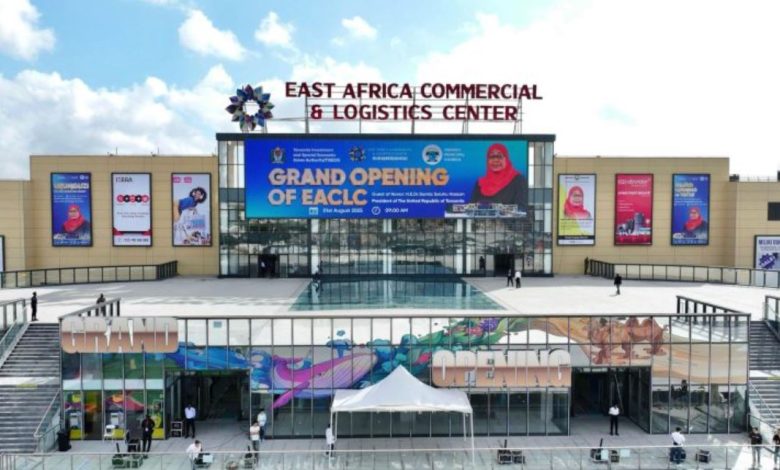
DAR ES SALAAM: IN 2025, the bustling commercial capital of the country, Dar es Salaam saw the launch of the state-of-the-art East Africa Commercial and Logistics Centre (EACLC), aimed at expanding trade, regional integration and the country’s industrialisation.
The EACLC which aims to position Dar es Salaam as the East Africa’s business epicentre was launched on August 1, by President Dr Samia Suluhu Hassan.
The iconic commercial and logistic hub located in Ubungo represents a total investment exceeding 170 million (over 424bn/-) with 75,000 square metres which accommodate 2,060 shops.
The EACLC is projected to reduce regional trade costs by 30 per cent, by integrating bonded storage, customs clearance, e-commerce, supply chain finance and re-export trade into one seamless platform.
Speaking during the grand opening ceremony in Dar es Salaam, President Samia urged manufacturers operating within the new commercial facility to prioritise and uphold high production standards for all goods.
She said that any product bearing the “Made in Tanzania” trademark must meet quality benchmarks, reflecting the nation’s reputation for excellence.
“Production standards are paramount because any product produced under the ‘Made in Tanzania’ brand must be synonymous with the high standards that the name Tanzania represents. I ask manufacturers to produce at acceptable standards,” President Samia said.
She further said that the facility is not meant to compete with established local markets like Kariakoo, but rather to complement and inspire them to adopt modern practices.
President Samia said Kariakoo traders should visit the centre, learn from its technology-driven operations and improve transparency in business transactions.
“Kariakoo has built a name for itself over the years, but it still needs to learn from this centre. Instead of viewing it as a competitor, let it serve as a learning model,”
President Samia said, adding that government systems will be integrated with the centre’s digital network to monitor business activities in real time.
She added that the centre will ease cargo handling processes at the Dar es Salaam Port, reducing turnaround time from seven days to less than three, thus boosting the port’s competitiveness in the region.
“Through its digital systems, the centre will enhance warehouse management, cargo tracking and transport coordination contributing to Tanzania’s vision of building a knowledge and technologybased economy in line with its digital strategy,” she said.
ALSO READ: EACLC set to drive industrialisation, regional trade integration
EACLC’s Director Dr Lisa Xiangyun said the business centre will boost Tanzania’s exports of agro-products including coffee, sesame, cashew and honey to China while also facilitating importation of high-end Chinese products especially machinery and consumer items, thereby boosting trade and industrialisation.
“It is not just a project, it is a promise fulfilled. EACLC is a love letter to Tanzania, combining Chinese expertise with African energy to build a modern trade ecosystem that serves the region and uplifts its people,” Dr Lisa said.
Adding “we are here to complement the local markets to bring in new international buyers, attract new consumer traffic and allow local traders to benefit from modern, world class facilities,” She insisted that the EACLC will be a magnet for manufacturing and regional trade.
“We aim to attract international manufacturers to establish processing and assembly facilities in Tanzania, serving the domestic market, the entire East African region, and beyond,” she said.
The commercial and logistics hub is also poised to leverage Tanzania’s position as key player in the African Continental Free Trade Area (AfCFTA) which is the largest trading bloc in the world.
Dr Lisa also detailed that the EACLC is establishing a five-in-one platform including the trade and logistics centre, a China-Tanzania overseas warehouse, an international exhibition centre, Zanzibar’s bonded airport logistics hub and a cross-border e-commerce platform.
Furthermore, she said that the EACLC will create 1500 direct jobs and over 50,000 indirect jobs while generating significant tax revenue to support national development.
She said the EACLC since commenced operation recently has already contributed over 22bn/- as revenue to the government of Tanzania saying the commitment is to generate more in the years ahead.
More notably, Dr Lisa said even during its construction phase, the EACLC project demonstrated commitment to local impact by creating over 3,200 valuable jobs to Tanzanians.
Dr Lisa extended appreciation to all government entities including the Tanzania Investment Special Economic Zones Authority (TISEZA) that turned the project into reality.
For his part, Minister of State in the President Office (Planning and Investment), Professor Kitila Mkumbo said the centre will increase business activities in Dar es Salaam. In Ubungo Constituency alone, he said it will bring the number of businesses to over 8,500 from the current 6,449.
“The number signifies rising of citizens’ living standard as increase of business activities lead to economic growth,” Prof Kitila said.
Meanwhile, TISEZA’s Director General, Mr Gilead Teri said the commercial hub will generate about 10 million US dollars (over 25bn/-) annually as taxes and makes an addition of 20,000 US dollars (500m/-) as levies and other charges including licensing.
More notably, the Ubungo Municipal Council which is collaborator of this project under a 32-year lease agreement will collect some 1bn/- per annum as rent from the land.
Mr Teri encouraged other municipal councils across the country to emulate Ubungo in facilitating mega investment projects by providing land. Commenting recently to the Daily News, business expert Dr Sylvester Jotta of the Saint Augustine University of Tanzania (SAUT) said the commercial centre will catalyse domestic, regional and international transactions, thereby stimulating economic integration –with Ubungo in Dar es Salaam serving as the epicentre.
As a result, he said Tanzania can generate more revenues from increased transactions which involve exports, imports and domestic trade.
“The Dar es Salaam City will experience a surge in business transactions like that of Dubai in which Tanzania as the country will generate massive revenues,” he said.
Furthermore, Dr Jotta said the centre will enable Tanzanian businesspeople to network with foreign traders from the Eastern African region and beyond, who will come to Tanzania to buy and sell goods through the facility.
He anticipated that the centre would boost the transport sector, supported by the electric Standard Gauge Railway (SGR), the Dar es Salaam Port and Air Tanzania Company Limited (ATCL), among others, which are key drivers of local, regional and international connectivity.
At the end, he said Tanzania will see its trade volume encompassing exports and imports with other countries especially China surging to a new height.
Dr Jotta said increased trade traffic comes with job opportunities to Tanzanians including retailers and drivers, supplying various goods from the centre.