Masks are on foreheads, mercury on hands
DESPITE the scarcity of safety gear in Tanzania’s artisanal and small-scale mining (ASM) sector, those who do have access to it often treat it more like decoration than a lifesaving necessity.
It is a perplexing paradox, because miners insist on mining, but not on surviving. Take this gem from Mr Richollins Kweka, a participant in the recent Empowering Women in Artisanal and Small-Scale Mining (ASM): Inclusive, Safe and Sustainable Mining Solutions workshop in Dodoma.
He recounted, “You might find someone crushing a gold stone in heavy dust with the mask on their forehead instead of covering the nose and mouth.” Apparently, the gear works best as a fashion statement. And if that is not enough, “It is also normal to find people on manual gold processing using mercury with bare hands,” he added.
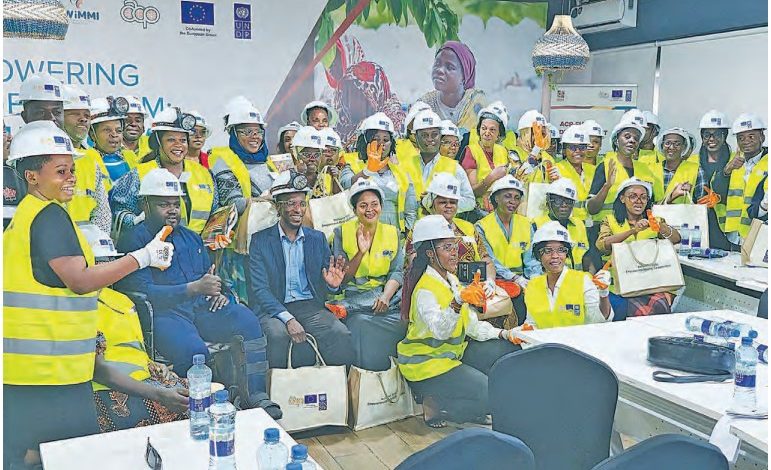
The workshop, organised by Tanzania Women in Mining and Mineral Industry (TWiMMI) in collaboration with UNDP, drew together a range of stakeholders to tackle the challenges faced by women in the ASM sector, while encouraging inclusive and sustainable mining practices.
Mr Kweka, who is active in mining development minerals like kaolin across Chunya, Morogoro and Dodoma, emphasised that the root problem is not only lack of access, it is also a deep lack of awareness.
He stressed the need for ongoing public awareness campaigns to educate miners on the risks of misusing safety gear and the long-term health complications that may arise. But safety gear is just one part of a bigger puzzle. Mr Kweka pointed out a critical gap in financial literacy, especially in basic record-keeping.
ALSO READ: Tanzania intensifies efforts to curb mercury use in ASGM
“The records will also smooth tax paying,” he said. He explained that revenue authorities like the Tanzania Revenue Authority (TRA) calculate tax based on profit, after all expenses including exploration, chemicals and tools. The problem? Most miners don’t keep such records.
“Unfortunately, the majority of ASMs seem to be missing those important documents, not out of negligence, but ignorance,” he said.
As a result, these miners often end up blaming the system, accusing it of ‘bullying’ through high taxation. On that note, Mr Kweka did not spare TRA either. He advised the authority to empower its officers better during tax estimations, arguing that current mineral tax rates are too steep and often poorly explained.
Still, he lauded the government’s efforts in opening up mineral buying centres, especially for gold. “It is a game-changer,” he said, but quickly added that other jewelry-related minerals deserve the same treatment. “Many of these minerals are only found at mining sites. Why not make access easier?” he asked.
The workshop also served as the launchpad for the Development Minerals Programme, a three-year initiative sponsored by the European Union, UNDP and the African, Caribbean and Pacific Group of States.
According to Mr Godfrey Nyamrunda, UNDP’s National Project Coordinator, the programme is active in Singida, Dodoma, Morogoro and Tanga, targeting the youth and women in the construction minerals sub-sector. One of the programme’s core missions is to promote environmental health and safety.
ALSO READ: NEMC wants mercury-free artisanal small-scale gold mines
“It is true that some miners have little understanding of the importance of protective gear,” said Mr Nyamrunda. “That’s why we are donating safety equipment to participants and providing training on how to use them properly.” But that’s not all. The programme also seeks to build financial literacy. “The real problem isn’t lack of money, it is lack of access to it,” he noted.
“We are addressing this by teaching miners how to keep records, how much they invest, how much they sell, their taxes, profits and even losses.” He emphasised the importance of value addition, saying miners need to shift their thinking. “Investing in development and construction minerals is far cheaper and more accessible in terms of capital and technology,” he said. He gave the example of laterite, a common construction mineral.
When mixed with cement and sand, it produces stabilised earth blocks, a low-cost solution for building, particularly in rural areas. Ms Palina Ninje, Chairperson of TWiMMI, echoed the call for continuous education.
“Most miners still believe mining only involves strategic minerals like gold and diamonds,” she said. “They shy away due to lack of capital and equipment. But there’s opportunity in construction minerals, they just don’t know it yet.” She also highlighted environmental degradation as a major issue. “Tree cutting at mining sites is rampant,” she said. But TWiMMI is taking steps. “We have planted thousands of trees across Dodoma and Lindi, and plan to plant 2,000 more in the Lake Zone before the year ends.”
As part of its environmental push, TWiMMI has distributed over 350 gas cylinders in Southern and Coast regions to reduce reliance on firewood and charcoal. The workshop’s opening remarks were delivered by Engineer Ally Samaje, Assistant Commissioner for Minerals and Mine Development at the Ministry of Minerals.
He emphasised that the government recognises ASM’s contribution to the national economy, especially in rural livelihoods. “According to the 2022 Population and Housing Census, over six million Tanzanians are involved in ASM activities many of them women,” he noted.
But, he said, women still face multiple barriers from lack of equipment to restricted access to capital, land rights and legal protections.
“These challenges are unacceptable,” he said. “Women in ASM are not just labourers. They are entrepreneurs, leaders and agents of change.” He stressed that, with the right support, women can shift from performing low-value, high-risk tasks to taking on high-value, leadership roles in the mining sector.
“Empowering women is not just about gender equity, it is about economic and national development,” Engineer Samaje concluded. There is no golden shortcut when it comes to mining safely and sustainably. Whether it’s wearing a mask properly or knowing how to file a tax return, the ASM sector in Tanzania stands at a crucial crossroads, between tradition and transformation.
Progress demands more than pickaxes and perseverance. It requires education, equipment, empathy and a healthy dose of common sense. Because let’s face it— gold dust in your lungs and mercury on your hands is nobody’s idea of treasure. It is time to dig deeper, not just into the ground, but into policies, knowledge and values that can truly make smallscale mining not only safe and sustainable, but smart.