Investment sector records remarkable transformation in 64 years
DAR ES SALAAM: YESTERDAY Tanzania celebrated the 64th anniversary of independence revisiting how the country’s investment landscape has been advancing is imperative.
In any independent country, the investment sector plays a crucial role in creating jobs, revenue generation, transfer of technology, improvement of citizens’ living standards and economic growth at large.
From its early post-independence days of a state-controlled economy to its current market driven approach, the country has undergone notable transformation into a promising investment destination in East Africa while maintaining its overarching goal of strengthening socio-economic and political independence.
These milestones echo Tanzania relentless efforts of improving business atmosphere which have been translated in all government phases, from the Father of the Nation, Mwalimu Julius Nyerere to the incumbent head of state, Dr Samia Suluhu Hassan.
Commenting on the transformation of the investment sector, Economic Diplomacy Expert, Professor Kitojo Wetengere based at the University of Arusha (UoA) said the improvement in business environment in all government phases reflected the need for all investors to contribute to well being of all citizens and the country’s economy development.
Prof Wetengere narrated that the country’s founding father Mwalimu Nyerere after independence in early 1960’s and his entire term in office ensured all colonial inherited investments are nationalised and natural resources including land and minerals are protected and utilised for citizens’ development.
Featured by the Arusha Declaration of 1967, the first phase government was committed to development of the African socialism (Ujamaa) with central planned economy where a number of industries and public services including schools were nationalised and wealth was evenly distributed to all people.
The state controlled major industries, with a focus on attaining self-reliance and equality. Prof Wetengere said the move amplified Mwalimu Nyerere’s lifelong vision of ending colonial economy and paving the way for Tanzanians to control their economy.
He said under the first phase government Foreign Direct Investment (FDI) remained few and in most cases was selective to specific countries with socialism roots like China and Russia in sector such as infrastructure in line with Tanzania interest of creating the people-centred economy.
He noted that despite stagnation in FDIs development during the first phase but the situation it was at good intent of Mwalimu Nyerere of preserving natural resources like minerals for future generations which he believed one day would possess required technologies and enough for undertaking sustainable investments which can upgrade citizens’ livelihoods and the country’s economy as whole.
“Unlike to colonial investors who were driven by their home countries demand of raw materials and cheap labourers, Mwalimu Nyerere wanted to ensure all investments benefit the Tanzania’s local community first and lead to value addition rather than exporting raw agricultural and mineral products,” Prof Wetengere said.
Came the second phase, the government under President Ali Hassan Mwinyi apart from continuing to uphold the country’s independence adopted the open economic policy to fit with new global dawn embedded with trade liberalisation and privatisation.
Prof Wetengere noted that under Mwinyi’s presidency, the government began the process of privatising inefficient state-owned enterprises and introduced policies to attract international investors, the transformative trajectory that was followed by his successors which are Mr Benjamin Mkapa, Dr Jakaya Kiwete, Dr John Pombe Magufuli and Dr Samia Suluhu Hassan.
“After President Mwinyi, our country continued to register significant improvement in business climate year after year, administration after administration,” Prof Wetengere told the “Daily News” in an interview over the weekend.
He highlighted that the development of business environment has been involving allocation of special areas for investors (industrial parks), promotion of peace, intuitional, ministerial, legal and policy reforms.
In 1997, the government led by President Mkapa established the Tanzania Investment Centre (TIC), the main agency for promoting and facilitating investments till to date.
Also, he lauded Tanzania’s good diplomatic relation with the fellow member states in the EAC and SADC by collaborating in trade and establishing joint economic infrastructures such as railways.
ALSO READ: Tanzania, Finland reaffirm to deepen cooperation in trade, investment sectors
As the result, Prof Wetengere said investors see Tanzania as gateway to the EAC and SADC markets.
He called upon the government to continue ensuring Tanzania is interconnected with other EAC and SADC’s countries through transport infrastructure including railways, roads and airports which are vital in accelerating regional trade and investments.
Prof Wetengere said presence of abundant natural resources including gas, minerals, water bodies; vast fertile land and wild animals in the country also attract investors.
In the first quarter (QI) of the 2025/2026 Financial Year covering July to September recorded remarkable 201 projects worth 2.5 billion US dollars (over 6 tri/-) expected to create over 20,800 new jobs.
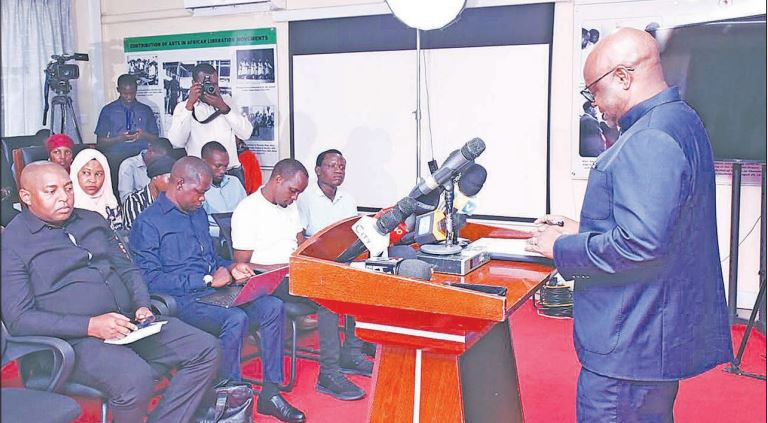
Briefing reporters recently in Dar es Salaam, Tanzania Investment and Special Economic Zones Authority’s (TISEZA) Director General, Mr Gilead Teri attributed the impressive strides in attracting investors to improvement of the business atmosphere by the sixth phase government under President Dr Samia Suluhu Hassan.
“The government under President Samia has continued to put in place easy and friendly investment environment. As a result, the investment rate has not declined despite the fact that our country is in the election period,” Mr Teri said.
Adding “economically, we define this as the trust that the investors and businesspersons across the world have to the president and her government. Tanzania remains a safe investment destination.”
Mr Teri said the statistics reflects the positive trends of the investment sector in four years hinting that the country for the whole year in 2021 registered 256 projects.
He said the data also signals consolidated efficiency of investment facilitation under TISEZA which became operational on July 1 as the resultant of the mergence of the Tanzania Investment Centre (TIC) and the Export Processing Zones Authority (EPZA).
More significanlty, Mr Teri said the government has adopted the new Investment Act of 2022 which offers incetives to all investors in ensuring that they get sound returns from their investments.
The new Investment Act of 2022 gives fiscal incentives to the expansion and rehabilitation projects from which investors can enjoy import duty-free for capital goods such as machines and plants, while the deemed capital good can access the import duty relief by 75 per cent while enjoying non-fiscal incentives including protection of their capitals under the TISEZA.
The new Act also reduced capital threshold for domestic investors to 50,000 US dollars (over 124m/-) from 100,000 US dollars ( about 248m/-).
Furthermore, he said the increase new investments is also due to the collaborative efforts involving Tanzania’s embassies across the world, TISEZA and other public entities which together have been creating promoting the country’s economic opportunities and their tailored incetives for investors.
Mr Teri said the country’s consistence upward trends in registering projects, capital inflows and job creation mirror the growing business confidence in Tanzania and TISEZA’s efforts in facilitating investments.
More significantly, he underlined the fact that President Dr Samia Suluhu Hassan through her 4R philosophy which stands for reconciliation, rebuilding, resilience and reforms has made strides toward inclusivity and transparency, aiming to bridge divides which can hinder economic growth.
Furthermore, Mr Teri said of all registered projects, investments in the Export Processing Zones (EPZs) that target the international markets were eight with an estimated value of 97.83 million US dollars (over 249bn/- ) due to generate 2,607 new jobs and 127 million US dollars (over 311bn/-) yearly as foreign currencies.
In term of sectors, he said manufacturing topped other sectors by recording 85 projects equivalents to 42.29 per cent followed by commercial building 30 projects (14.93 per cent) and transport 29 projects (14.43 per cent).
Regarding Foreign Direct Investment (FDIs) by countries, he said the United Arab Emirates (UAE) led other countries in injecting capital in Tanzania by making a total 502 million US dollars (over 1.2tri/-) followed by China 401.55 million US dollars (about 986bn/-) and India 176.18 million US dollars (433bn/-).
In a related development, Mr Teri said TISEZA has launched a special campaign for investing in the five Special Economic Zones (SEZs) which include Buzwagi SEZ in Shinyanga spanning 1,333 hectares, Bagamoyo Eco Maritime City SEZ (151 hectares), Kwala SEZ in Coast Region (40.5 hectares), Nala SEZ in Dodoma (607 hectares) and expanding the existing Benjamin William Mkapa SEZ in Dar es Salaam with over 13,000 square metres.
He said any interested Tanzanian to invest in the aforementioned SEZs will be granted a cost-free project land to establish his or her industry within 12 months focusing in priority sectors encompassing fast-moving consumer goods such as textile, pharmaceuticals, furniture and car assembling.
Commenting on Tanzania’s impressive feat in attracting investments, Economist cum In vestment Banker, Dr Hildebrand Shayo said Tanzania is a great destination to launch a business due to its business-forward orientation and low-risk environment.
“Tanzania presents exceptional economic potential as a result of its beneficial tax system, legal and regulatory framework, legislative autonomy and competitive market fundamentals” Dr Shayo told the “Daily News.”
Furthermore, Dr Shayo said Tanzania’s pivotal commercial centre in the East African Community’s (EAC) area supported enhanced business environment increasingly makes the country becomes a desirable destination for investors.
In another development, he attributed the achievement in attracting investors to the development of economic infrastructure including roads, airports, railways and ports.
“Tanzania is going to have one of the greatest infrastructures in the region, in contrast to the rest of the EAC” Dr Shayo noted citing the on-going construction of the electrified Standard Gauge Railway (SGR).
Nevertheless, he appreciated the government under President Samia for embracing a proactive and transparent strategy to draw in FDIs which position the nation as a pro-business focal centre.
Geographically, Tanzania is bordered by eight countries including Kenya, Uganda, Rwanda, Burundi, the Democratic Republic of Congo, Zambia, Malawi and Mozambique and has been providing vital access to the Indian Ocean through the Dar es Salaam and Mtwara ports. Such geographical advantage makes the country serves as the catalyst of trade in the EAC and the Southern African Development (SADC).
Business Expert Dr Sylivester Jotta, who doubles as the entrepreneurship lecturer at the Saint Augustine University of Tanzania (SAUT) attributed the country’s success in keeping attracting investments to presence of predictable business policies and laws which give confidence to investors.
Also, Dr Jotta appreciated President Dr Samia for undertaking ministerial structure reforms by formulating the Ministry of Planning and Investment under the President Office namely President Office (Planning and Investment).
He said by placing the ministry under the president’s office, Dr Samia amplifies the country’s commitment to boosting investments.
The ministry is mandated on among others to formulate and monitor implementation of policies on investment, coordination of promotion and facilitation of Domestic and Foreign Investment as well as monitoring performance of extra ministerial departments including the TISEZA affairs.