Fresh impetus for blue economy
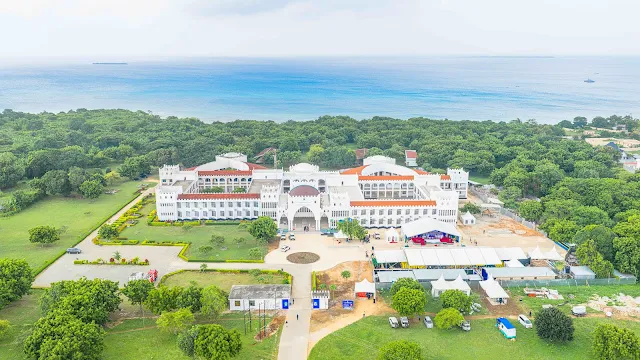
DAR ES SALAAM: PRESIDENT Samia Suluhu Hassan has said the University of Dar es Salaam’s Institute of Marine Sciences (UDSM–IMS) in Zanzibar plays a central role in advancing blue economy through research, innovation and sustainable management of marine resources.
She said the institute plays a strategic role in generating scientific knowledge that supports marine conservation, climate change response, marine tourism and the sustainable use of ocean resources, areas she described as central to Zanzibar and Tanzania’s economic future.
“UDSM–IMS is a strategic institution for Zanzibar and for our country as a whole. As a nation with a long coastline and islands, our development future is directly linked to the ocean,”
President Samia said in Zanzibar yesterday while launching a new UDSM–IMS academic and administrative buildings, as part of activities to mark the 62nd anniversary of the Zanzibar Revolution.
She said the Revolution finds its true mean ing when it is accompanied by continuous economic, social and technological transformation, stressing that such progress cannot be achieved without deliberate investment in education, science, technology and research.
“These buildings are evidence that the Revolution is an ongoing journey of building a knowledgeable society, a strong economy and citizens who can compete in today’s technologically advanced world,” she said.
“For Zanzibar, the blue economy is very important in increasing income and creating employment opportunities. This investment in higher education will help stimulate inclusive growth and unlock opportunities within the marine sector.”
Dr Samia further said research and knowledge produced at the institute will support policy decisions that protect marine resources while increasing productivity for the benefit of the current generation and generations to come.
President Samia called on the institute to introduce short, practical training programmes aimed at benefiting surrounding communities so that they can improve productivity and participate fully in the blue economy.
ALSO READ: TASFAM injects 117m US dollars to boost the blue economy
She also urged lecturers and researchers to strengthen collaboration with the private sector, government institutions and communities, to ensure that research conducted at the institute produces direct and practical development outcomes.
Addressing students, the president encouraged them to use the available opportunities fully, study diligently and conduct innovative research, while serving as ambassadors for the protection and sustainable use of marine resources.
“Do not forget that our ocean is also very important for the security of our country,” she said.
President Samia thanked the World Bank for its productive partnership through funding provided under the Higher Education for Economic Transformation (HEET) project, noting that several universities in the country have benefited.
She said the institute is expected to remain a centre for scientific advice on marine and coastal environmental issues and a hub for international research, describing it as the only highly specialised marine science centre in the East African region.
Former President and UDSM Chancellor Dr Jakaya Kikwete said the HEET project, implemented by the government in partnership with the World Bank, has enabled the university to improve infrastructure, the teaching and learning environment.
“UDSM received three specific directives from President Samia regarding HEET funds. She directed the construction of the academic and administrative building, the construction of two new campuses in Lindi and Kagera regions, and implementation is progressing well,” Dr Kikwete said.
He said the university is requesting the completion of a girls’ hostel, construction of a hostel for male students and acquisition of a research vessel to enable students and lecturers to conduct marine research.
President Samia said requests presented by the institute’s leadership would be taken on board and worked on, expressing the government’s expectation that UDSM–IMS will continue to be a key stakeholder in the development of the blue economy.
UDSM Vice-Chancellor Professor William Anangisye said the Institute of Marine Sciences was established in 1978 with a mandate to conduct research, offer postgraduate studies and provide advisory services.
He said the institute began enrolling postgraduate students in the 2006/2007 academic year as demand for marine science specialists increased.
“As part of implementing the blue economy policy, IMS proposed the introduction of undergraduate programmes, but the original site had no space for additional buildings,” Prof Anangisye said.
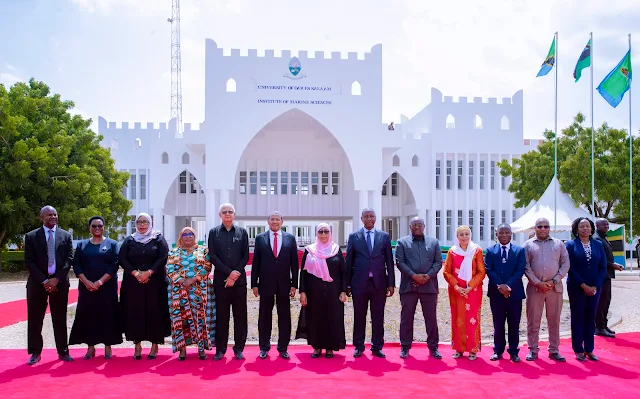
He said the investment reflects UDSM’s responsibility to generate knowledge that contributes directly to economic, social and technological development within and beyond Tanzania.
Prof Anangisye said the project is being implemented under the HEET initiative, through which UDSM was allocated 49.5 million US dollars for five years starting in 2021.
He said completion of the new buildings will increase student intake from 172 to 472 per year, an increase of 300 students annually, expanding access to higher education.
“This will also strengthen the university’s capacity to contribute to national development through research, particularly in the blue economy, by providing solutions at various levels,” he said.
Minister for Education, Science and Technology Professor Adolf Mkenda said the HEET project implemented in 16 regions covers 47 sites, with 130 new buildings, 309 laboratories and workshops, 26 dormitories and hostels, as well as libraries, offices, staff houses, health centres and cafeterias, alongside rehabilitation works in 48 facilities.
Prof Mkenda said in Pemba, construction is ongoing for an Open University centre, while Mwalimu Nyerere Memorial Academy is also building a campus to complement the existing one in Unguja.