Feeding the Islands: Why Zanzibar is struggling to grow enough rice
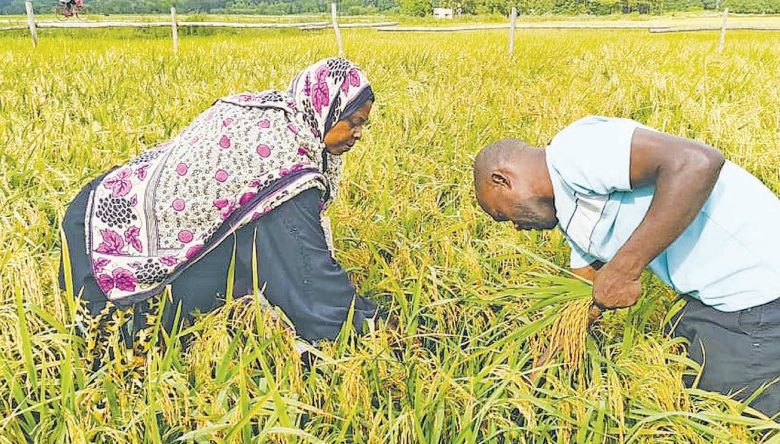
ZANZIBAR: IN the rice paddies of Kibonde Mzungu, early morning mist clings to the surface of flooded fields while farmers set to work transplanting seedlings. For these families, rice is more than a crop, it is central to food security, tradition and income.
Yet, despite their dedication, Zanzibar still cannot produce enough rice to feed its own people. Rice is the most important staple food in Zanzibar. It features on the table of nearly every household and provides a significant portion of daily calories for island residents.
But the local rice sector has long struggled to keep pace with demand, forcing the semi-autonomous archipelago to rely heavily on imports from Tanzania mainland and beyond.
According to recent agricultural data, domestic rice production in 2024 amounted to approximately 41,410 tonnes, significantly below the nation’s consumption needs. Government planners estimate that Zanzibar’s annual rice demand stands at around 100,000 tonnes, with nearly 80 per cent of that demand currently met through imports.
The gap between local production and consumption reflects longstanding structural challenges in the agriculture sector from limited irrigation infrastructure to low yielding crops and insufficient access to modern technology. But it also highlights the importance of rice not just as food, but as a cornerstone of economic and social stability in Zanzibar.
Challenges in the fields
Farmers in irrigation valleys such as Kibonde Mzungu, Kilombero, Chaani and others have seen firsthand how fragile production can be. A breakdown in a single water pump can stop cultivation entirely, as happened recently when a key irrigation pump failed and left farmers unable to plant or tend their crops.
At a meeting convened to address the breakdown, Mr Saleh Mohamed Juma, the Permanent Secretary of the Ministry of Agriculture, Irrigation, Natural Resources and Livestock, reiterated the government’s commitment to working with farmers to tackle such challenges.
“We must support farmers not only with infrastructure but also through training and maintenance strategies so that when systems break down, we can respond quickly,” Mr Juma said.
ALSO READ: Tanzania’s youth and digital economy: Rethinking social media’s role
He explained that local leaders, farmers and the government had agreed to pool resources to purchase a new pump, underscoring the importance of collective action in sustaining irrigation systems. Farmers, for their part, highlighted the precariousness of their situation.
“When the water stops, we lose not just this season’s crop but a season of income for our families,” said Ibrahim Kombo, a farmer. “We are ready to work hard, but we need reliable water and support.”
Irrigation as the path forward
Responding to these needs, the government has placed irrigation development at the centre of its strategy to boost rice production.
In the 2025/2026 financial year, the Irrigation Development SubProgramme outlines plans to review the 2002 Irrigation Master Plan to align it with current challenges and opportunities; Other plans are to rehabilitate 10 irrigation valleys across the islands; repair broken boreholes and pumps crucial for water supply and expand the use of drip irrigation systems to maximise water efficiency.
These interventions aim to increase the area under productive rice cultivation and reduce seasonal reliance on unpredictable rainfall. The ministry hopes that, over time, better water management and irrigation technology will help narrow the gap between production and demand.
Already, investments in seven irrigation valleys covering 1,354 hectares have begun to pay dividends. When functioning well, modern irrigation systems boost yields from an average of 3–5 tonnes per hectare in rain-fed settings to 8–11 tonnes per hectare, with long-term aspirational targets of 15 tonnes per hectare under improved management.
More than just water
While irrigation is critical, experts stress that it is only one piece of the puzzle. Boosting rice output also requires improved seed varieties adapted to local conditions; access to fertilisers and mechanisation; better extension services that teach farmers modern cultivation practices and enhanced post-harvest processing and storage to reduce losses. Zanzibar’s rice potential remains strong.
The islands possess over 8,500 hectares of irrigable land, and the government believes that, if fully utilised with modern practices and technologies, domestic rice production could supply a much larger share of local needs than it currently does. For farmers like Ms Fatma Abdullah Ali, the stakes are personal.
A mother of four, she depends on rice fields not only to feed her family but also to generate income to pay school fees and household bills.
“If we only grow enough for our own table, we still worry about the future,” she says, kneeling in the muddy soil. “We want to sell our rice, earn more and see our children go to school without hunger.”
Similarly, Mr Juma Hamid Omar, another Kibonde farmer, notes the psychological toll of uncertainty. “When the rains fail or the pump stops, we feel helpless,” he says. “But when we see water flowing through our canals, we feel hope. We know we can plant again.”
Bridging the gap
Despite progress, the gap between production and consumption remains wide – roughly 60,000 tonnes short annually if Zanzibar is to meet its estimated 100,000-tonne demand. Farmers and officials agree that closing this gap will take sustained effort and investment.
“The government recognises how critical rice is to food security,” said Minister Suleiman Masoud Makame, emphasising the importance of irrigation and modern farming techniques.
ALSO READ: A New Year for business data-driven decisions
“We are working to create conditions where rice farmers can thrive.” As the sun sets over the irrigated fields of Unguja and Pemba, the rhythm of daily life continues, farmers tending crops, families waiting for harvests and policymakers striving to make Zanzibar self-sufficient in its most essential food.
The path ahead is steep, but for the thousands who depend on rice, the work underway offers a promise that, one day, the islands may grow enough of their own grain to feed every home.